 Last updated December 23, 2025
  read
read
What is swatting and how to prevent it – 5 tips to protect yourself
Anyone can be a swatting victim — gamers, celebrities, and everyday people alike. If your personal information is available online, you could be at risk of becoming a swatting target.
In this guide, we explain what getting swatted means, who is most at risk, and how to protect yourself. We’ll also examine real-world incidents to show why swatting is a serious public safety issue.
Swatted definition: what does getting swatted mean?
So what is swatting anyway? It is often defined as a dangerous form of harassment that involves making a false emergency report to trigger a SWAT team response at the target’s location. In a typical swatting incident, a caller uses a victim’s address to contact 911 and falsely report an urgent, life-threatening crime, such as a hostage situation, bomb threat, or active shooter.
Although sometimes dismissed as a “prank,” swatting poses serious risks to victims, their families, neighbors, and responding officers. According to the National Association of Attorneys General (NAAG), swatting incidents have increased in recent years across both large and small U.S. jurisdictions. Federal agencies have also raised alarms — the Federal Bureau of Investigation, Federal Protective Service and others have issued alerts and guides warning that swatting is a growing public safety threat.
What is a swatting incident, and how does it happen?
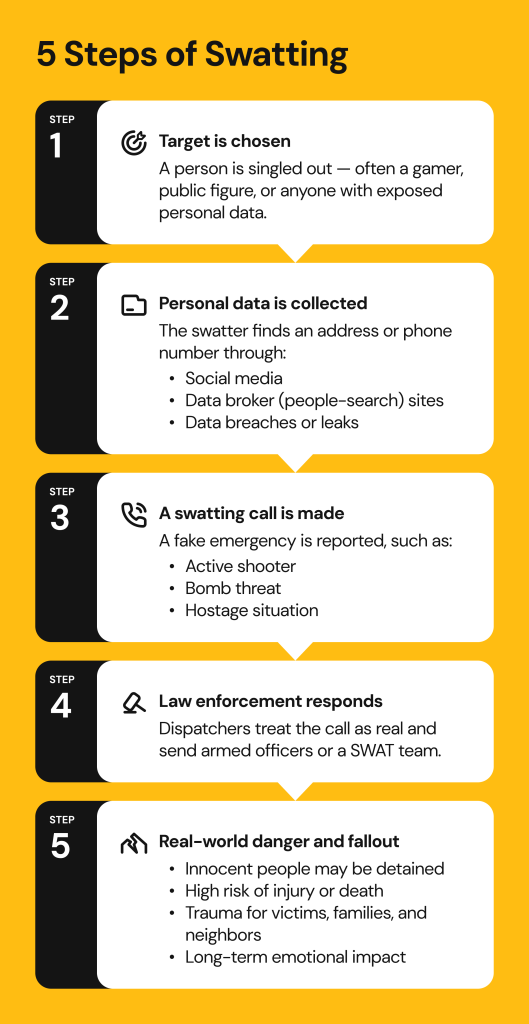
A swatting incident follows a predictable pattern. While the details vary, most cases unfold in a similar way.
Why is swatting dangerous?
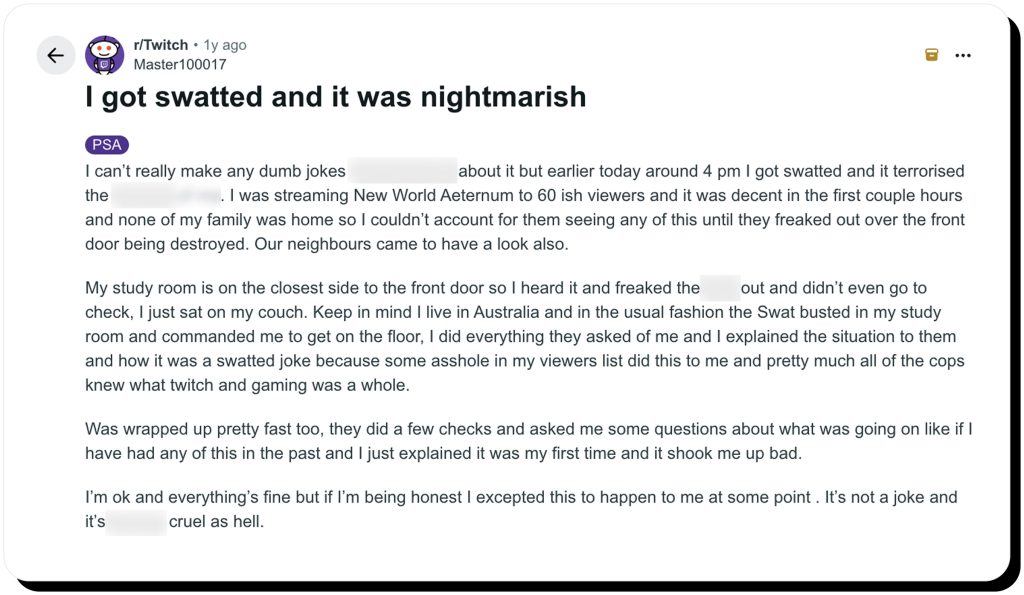
From the victim’s perspective, getting swatted is sudden, confusing, and terrifying. Police arrive without warning, surround the property, force entry, and detain occupants while they search for a threat that does not exist. Victims are typically unaware that a false report has been made in their name until law enforcement is already on scene.
The consequences are also anything but harmless. Swatting incidents can result in innocent people being detained at gunpoint, severe psychological trauma, property damage, and in some cases, serious injury or death. As personal information becomes easier to find online, swatting has evolved from a fringe online stunt into a real public safety threat affecting everyday people, not just celebrities or streamers.
Is swatting illegal?
Yes, swatting is illegal under a variety of federal and state laws in the United States.
At its core, swatting involves making false emergency reports, which is a crime in all U.S. states. Depending on the circumstances, perpetrators may face charges such as:
- False reporting or hoax threats
- Interstate threats or communications
- Fraud or impersonation
- Reckless endangerment
When a swatting incident results in injury, death, or large-scale disruption, charges can escalate to felonies with long prison sentences. Thus, in 2017, a swatting incident resulted in the death of a 28-year-old man, Andrew Finch, after a dispute over a Call of Duty match. The player responsible for the swatting, Casey Viner, was sentenced to 15 months in prison; the man who made the call at his request, Tyler Barriss, received 20 years.
How do swatters get your information?
Swatting relies on access to personal data. In many cases, the information used is publicly available or easily obtained online.
Data broker and people-search sites
These websites collect and sell your data without your consent. Not only do they expose your name, address, and other contact details, but they also share info on your family, your financial status, property ownership details, etc., making it easy for anyone to look up a home address and other details in seconds.
Social media oversharing
Photos, location tags, livestreams, and public posts can reveal where someone lives or frequently visits, even if an exact address is never shared.
Data breaches
Exposed databases containing addresses, phone numbers, or account details can give attackers everything they need to impersonate a victim.
IP addresses and location data
In some cases, attackers use IP addresses, gaming servers, or location-sharing services to narrow down a victim’s physical location.
This is why swatting is closely tied to online privacy — the more personal data is exposed, the easier it becomes to target someone.
Why do people swat others?
Swatting is usually motivated by one or more of the following:
- Harassment or revenge after an online dispute
- Intimidation, especially against activists, journalists, or public officials
- Attention-seeking, particularly when incidents are livestreamed or reported
- Thrill-seeking, driven by chaos and anonymity
- Coordinated or paid attacks, where swatting services are offered for money.
Your swatting risk factor
We’ve taken the time to collect incident stats and analyze which groups of people are more at risk. Want to know which risk group you fit into? Read on to find where you stand, so you can take the necessary measures to reduce your chances of being swatted.
Risk group 1: Severe swatting risk
- Celebrities and public figures
- Journalists
- Activists
- Social media influencers (Instagram, TikTok, YouTube bloggers, popular video game streamers)
Plenty of celebrities were victims of swatting — Miley Cyrus, Chris Brown, Justin Bieber, Jason Derulo, Ashton Kutcher, Tom Cruise, Nicki Minaj, Jack Doherty and the list goes on.
Jojo Siwa is one of the celebrities who got swatted not once, but twice. In 2021, she claimed the press might have been behind the incident, hoping to get her out of the house. In 2024, she got swatted again, right after releasing a new album.
The first woman and person of color to serve as Mayor of Boston, Michelle Wu, got swatted in 2023. The attack happened on Christmas, when a trickster reported a crime at the mayor’s address. Unfortunately, swatting against governmental officials is becoming increasingly common.
Risk group 2: High swatting risk
This group includes people who interact online with others. You are at risk if you are:
- An active contributor to an online community
- An online gamer or a streamer
- Active on social media (you share your thoughts and stories a lot, you comment a lot, and your account is not in private mode)
Popular streamer Adin Ross has been swatted multiple times throughout 2022 and 2023 — including while streaming from his home and from a boxing gym. The repeated incidents were serious enough that local police reportedly adjusted how they responded to emergency calls involving his address.
Sometimes you don’t even have to be active on social media. All you need is a username that some people may find attractive. Such is a shockingly sad story of Mark Herring, 60, who refused to give up his coveted Twitter handle @Tenessee and died of a massive heart attack in April 2020 as a result of a brutal swatting incident arranged by a 20-year-old perpetrator who wanted to get the lucrative username and then resell it.
Risk group 3: Moderate swatting risk
People who are not active online but have their personal information exposed on the internet. It’s enough to have your contact details, such as your phone number and home address, published by people-search sites like MyLife, Spokeo, Whitepages, Instant Checkmate, and many others.
Unfortunately, anyone can access the information presented on these sites. Therefore, if someone wants to get you back for something, they can always find your information on these web pages and prank call the cops under your name, and direct people to your home.
How to protect yourself from swatting: tips to reduce your risk
It’s easy to see that swatting has become a genuine threat for many. No matter whether you’re a gamer, have published articles sprawled online, work a casual job, are a stay-at-home mom, or are a celebrity, everyone is at risk.
Before unveiling more swatting-related stories, let us arm you with some actionable tips on how to get your information off the web to make sure you avoid becoming yet another swatting incident statistic.
#1 Limit personal data exposure
Avoid sharing your home address, phone number, or real-time location publicly whenever possible. Sharing information with strangers opens you up to the risk of doxxing, as well. Doxxing happens when someone takes your private or semi-private information and makes it public, sometimes even encouraging harassment. It’s often a perquisite to swatting.
#2 Lock down social media privacy
Set accounts to private, remove location tags, and be cautious about livestreaming from identifiable locations.
#3 Remove data broker listings
Opt out of people-search sites that publish your personal details. This step alone can dramatically reduce how easily someone can target you.
You can go the free route and manually remove your data by following our step-by-step opt-out instructions here. It’s vital to note that data broker sites tend to re-list your information again a few months later, so be sure to check back again.
If you don’t feel like putting in that much effort, use the Onerep tool, which will automatically take your info off of data brokers for you.
Onerep removes your information from 317 data broker sites, and keeps monitoring the web to make sure your information remains private. 👉Sign up free.
#4 Secure your IP address and mask device data
Using security tools that limit IP exposure can reduce location-based targeting.
#5 Talk with household members
Make sure everyone in your household understands the risks of oversharing personal information online.
Reducing your digital footprint lowers the chances that someone can weaponize your data against you.
Why swatting is a public safety issue
Swatting doesn’t just harm individual victims. It diverts emergency resources, puts first responders at risk, and can delay responses to real emergencies elsewhere. Repeated hoax calls also strain dispatch systems and erode trust in emergency services.
As federal and state agencies have warned, swatting is not only a cybersecurity issue — it’s a real-world threat with life-or-death consequences.
FAQ
Is swatting illegal in California?
Swatting is a crime across all US states. There isn’t an anti-swatting law per se, but in California, there are laws that prohibit misusing 911 to harass others, falsely reporting an emergency, or making a false report of a crime. Perpetrators guilty of swatting may face fines or jail time (or both). If swatting leads to injury or death, swatting can easily become a felony, and you may face civil liability.
What is a swatting call?
A swatting call is a call to 911, reporting a fake emergency at someone’s address. It’s always an urgent, serious crime, such as a murder, active shooting, hostage situation, or a bomb threat. A swatting call may not always be directed to a specific person. Swatting also happens in public places, such as schools, malls, or metros. It’s not a prank, but a crime that can result in violence, injury, or even death.
What is a swatting incident?
Getting swatted, by definition, involves a SWAT team breaking into your home because of a fake, hoax emergency report. Swatting happens when someone calls 911 and reports a serious crime happening at your house, as an act of intimidation or revenge.




Mark comes from a strong background in the identity theft protection and consumer credit world, having spent 4 years at Experian, including working on FreeCreditReport and ProtectMyID. He is frequently featured on various media outlets, including MarketWatch, Yahoo News, WTVC, CBS News, and others.