 Published December 1, 2025
  read
read
What is bait-and-switch? Meaning, examples, and how to avoid it
Bait-and-switch scams are a perfect illustration of the old adage—if the offer is too good to be true, it probably is. This is one of the oldest tricks in both marketing and online fraud—to advertise some tempting offer (the bait) and then substitute it with something inferior or more expensive (the switch).
While some unscrupulous marketers use bait-and-switch tactics to get new customers, online scammers plainly deceive their victims, taking money for products that don’t exist, don’t belong to them, or are of much poorer quality than the advertised version.
This guide will walk you through the bait-and-switch definition, common examples of such scams, and steps you can take to protect yourself from falling for them.
Bait-and-switch meaning and definition
What is bait-and-switch? In broad terms, bait-and-switch is a tactic of false advertising using a highly appealing (and misleading) offer to attract customers, but swapping this offer with a much worse, more expensive, or less desirable option during the actual selling process.
The definition may differ depending on where and how this scheme plays out:
- In marketing and sales, this tactic can be applied to initially lure customers with a too-good-to-be-true offer or an unbelievably low price but then state that this product is out of stock or not available for other reasons, pushing customers to buy a costlier option instead.
- In retail scams, especially in e-commerce, bait-and-switch techniques are used by fraudsters to advertise and sell a seemingly great product via fake listings but ship its inferior or counterfeit version, especially on resale or peer-to-peer shopping platforms.
In all cases, customers are made to take the “bait,” believing they’re about to buy a rare or exclusive product at a great bargain. In the end, though, their expectations get shattered and their trust abused when they get to see the “switch,” especially if they make advance payments for something purchased online.
Common tactics used in bait-and-switch scams
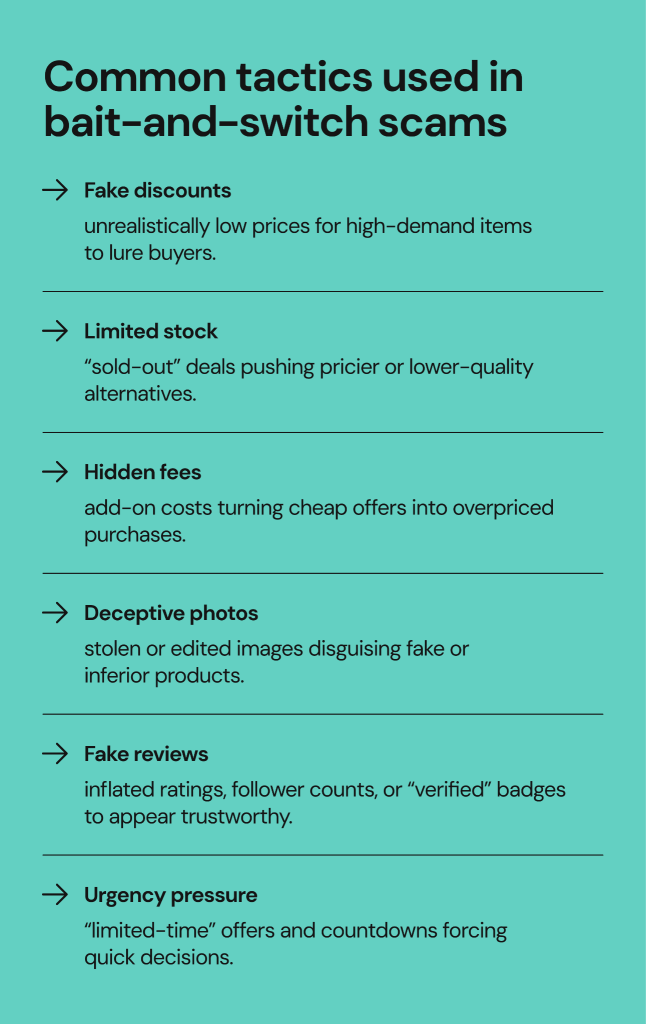
Bait-and-switch tactics are used across physical and digital environments such as stores, online ads, social media, job boards, and rental sites. You’re likely to encounter them in the form of:
- Fake discounts and other too-good-to-be-true offers posted online, such as for high-demand designer items or rentals at steep discounts to attract buyers and applications.
- Limited-stock options that turn out to be sold out once a customer inquires about them. Malevolent sellers often claim the item is out of stock and push for more expensive alternatives. Many find they don’t want to waste any more time and agree to this substitute, making bait-and-switch a profitable yet still unethical and often illegal marketing tactic.
- Hidden fees that add up to the advertised price, making the final bill exorbitantly high compared to market alternatives. This is a common tactic in duct cleaning scams, where the final price with all the add-ons can easily run as high as thousands of dollars instead of the initial $99 advertised.
- Deceptive photos and descriptions using stolen or manipulated images of luxury items, flats for rent, and other products, while in reality these are fake listings to attract buyers. Once the item is paid for, the seller may ask for more money before delivering the product, ship a counterfeit or much cheaper version, or just disappear.
- Social proof manipulation, where scammers add fake reviews, inflate follower counts, or add fake “verified” badges to their profiles to appear legitimate.
- Pressure to act now, using limited-time offers or countdown timers to create a fake sense of urgency and prompting the user to interact with the ad or listing as quickly as possible.
Examples of bait-and-switch scams
Bait-and-switch examples can take many forms, attracting people with offers that can’t be missed but exploiting trust to steal money or personal information.
Online shopping fraud
People encountering online shopping scams were reported to lose money in 80% of cases, while related scam reports to the FTC for the first half of 2024 were close to 172,000 in the U.S. alone.
Fake and counterfeit listings take the lead as bait-and-switch fashion resale scams on online peer-to-peer marketplaces. With anonymous profiles and multiple ways to avoid buyer protection policies, online scammers thrive by swapping seemingly legitimate items with their counterfeit, cheap, or completely different versions.
Facebook Marketplace scams are particularly common, with many users complaining about fake listings that advertise rare or high-end products for low prices but never deliver the items. Other resale platforms are no exception either: buyers report receiving empty boxes instead of their legit purchases as a common OfferUp bait-and-switch scam, while those agreeing to bypass available buyer protections often end up with money lost in Depop scams.
Fake rental ad scams
It’s reported that one in three renters encountered a fake rental listing during their search in 2025.
NBC makes a case about legitimate real estate agents being impersonated on social media by scammers who post stolen property ads but drastically drop the price (from as high as $12,000/month to $1,700/month in New York, for example). Attracting renters’ attention this way, they then defraud people by requesting them to pay application fees and disappearing along with the fake ads.
Airbnb bait-and-switch scams are also common. Unscrupulous hosts advertise highly attractive vacation rentals but, once those are booked, swap them at the last minute with a less appealing option for the same price due to some invented reason (repair works in progress or property being unavailable). Many stranded travellers agree to this, losing money on clearly overpriced accommodation.
Malware disguised as legitimate products
A particular type of bait-and-switch fraud is disguising malware as attractive online ads. Scammers may post ads for high-demand items such as free e-books, heavily discounted products, job posts, or rentals, but once the user clicks the ad, a malicious download starts in the background, installing malware on the user’s device automatically. Such malware can then scrape and steal the user’s personal information and account credentials.
NFT scams
With the rise of cryptocurrencies and NFT auctions, NFT scams have also proliferated, attracting people who are looking to make quick money but end up dealing with fraudsters. For example, a variation of bait-and-switch on NFT websites involved scammers bidding for a digital artwork in a certain cryptocurrency but then switching the crypto type at the last moment, making their initial bid much lower in value.
Is bait-and-switch illegal?
Yes, bait-and-switch is illegal in many countries with strong consumer protection authorities. In many instances, violators may face criminal prosecution, fines, civil action, business bans, and even imprisonment.
- In the U.S., the Federal Trade Commission (FTC) prohibits bait-and-switch as deceptive and unfair business practices under Section 5 of the FTC Act.
- In the U.K., bait-and-switch advertising is considered misleading under the Consumer Protection from Unfair Trading Regulations.
- In the EU, the Unfair Commercial Practices Directive bans bait-and-switch tactics as misleading commercial actions.
Engaging in bait-and-switch scams for the purposes of stealing money or personal information is illegal in all cases and is subject to criminal prosecution.
However, genuine pricing errors or legitimate out-of-stock items do not typically qualify as bait-and-switch as long as the seller had no intention to mislead or deceive the buyer.
How to spot bait-and-switch scams
Recognizing a bait-and-switch advertisement can help you avoid stress, wasted time, and lost money. Here are the top warning signs to watch out for:
- Prices that are much lower than similar products on the market.
- Sellers refusing to meet in person to inspect the item and pushing for peer-to-peer irreversible payments via wire transfers, Venmo, Cash App, and similar services.
- Last-minute product substitutions or excuses for out-of-stock or otherwise unavailable items.
- Hidden fees added after making the deal.
- Suspicious seller profiles with a lack of reviews, mismatched contact details, stolen or AI-generated photos, and requests to take your communication off the shopping platform to avoid buyer protections.
If you feel something is off when negotiating a purchase or rental online, take these precautions:
- Always verify the realistic market price on official websites.
- Check seller reviews and social media profiles for signs of a potential scam.
- Never pay for an item upfront without inspecting it first or making sure you can get a refund under the store’s buyer protection policy.
- Never share your sensitive personal information with unverified strangers on social media or third-party websites.
- Use secure payment methods that offer buyer protection, for example, PayPal Goods & Services.
What to do if you fall for a bait-and-switch scam
If you suspect you’ve been targeted in a bait-and-switch, take the following steps:
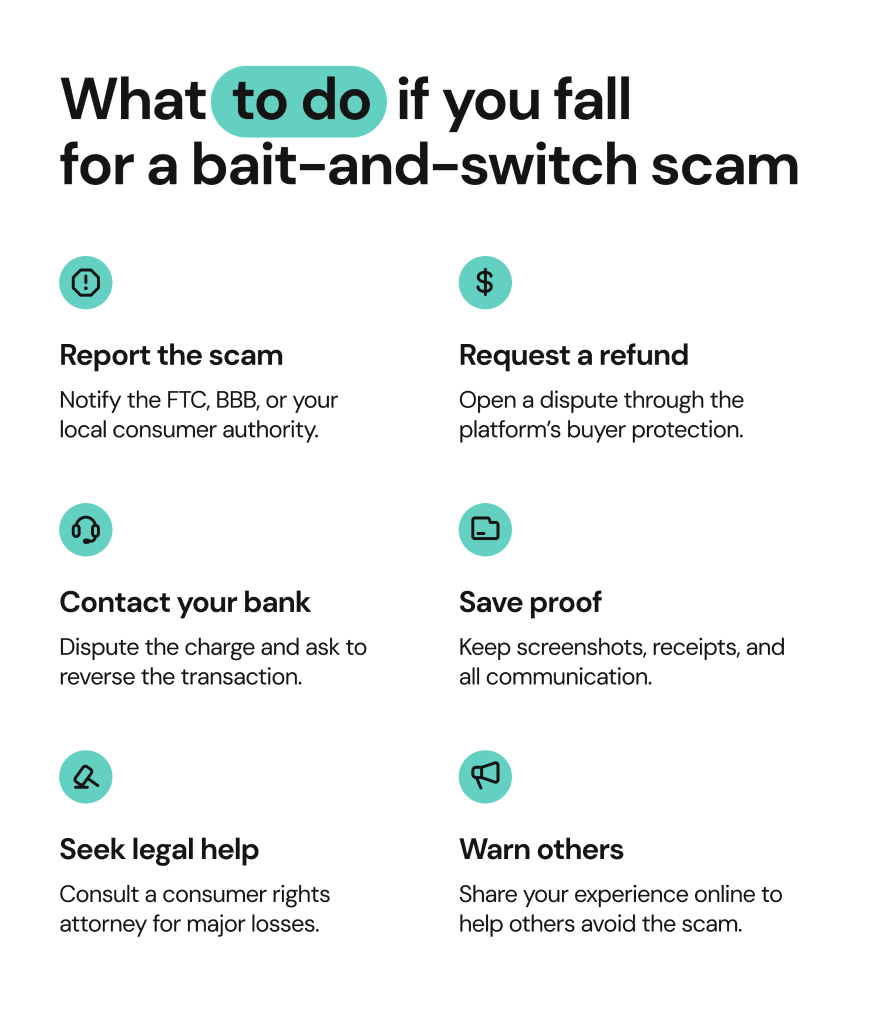
- Report this illegal business practice to the relevant local authority, for example the FTC or the Better Business Bureau in the U.S.
- If you bought the item via an online resale platform, check if you qualify for their buyer protection and can get a refund by opening a dispute with the seller. This option, however, is only available if you conduct the entire transaction through the platform, not through private messengers or peer-to-peer money transfers.
- Contact your bank or payment card provider to dispute and reverse the transaction as fraudulent.
- Document all the evidence of the scam, including screenshots, shared documents, and receipts.
- For substantial losses, consider consulting a consumer rights attorney.
- Share your experience on forums and social media, and post a public review of the fraudulent seller to warn others.
FAQs about bait-and-switch scams
What does bait-and-switch mean?
Bait-and-switch is a deceptive marketing or scam tactic where an unscrupulous seller lures buyers with a seemingly great and cheap offer but replaces it with a poorer or more expensive alternative.
How does a bait-and-switch scam work?
Bait-and-switch scams start with a too-good-to-be-true offer (at a very low price, a great discount, rare, or exclusive), but once a customer shows interest, the initial offer is substituted with a less desirable alternative. The worst case scenario is an online shopping bait-and-switch scam where the buyer gets nothing after having paid the full price for the product.
What is an example of a bait-and-switch tactic?
One example could be a Facebook Marketplace seller advertising a new iPhone 15 for $400 but then claiming it’s out of stock and pushing an older model for $600.
Is bait-and-switch the same as false advertising?
They overlap, but bait-and-switch, in particular, involves changing the product or offer after attracting buyers’ attention.
Is bait-and-switch illegal?
Yes, bait-and-switch is illegal in many countries as a malicious and misleading business tactic. As a type of scam, it can result in legal action and criminal prosecution of perpetrators.




Dimitri is a tech entrepreneur and founder of Onerep, the first fully automated data removal service. Top cybersecurity CEO of 2021 by The Software Report.