 Last updated January 29, 2026
  read
read
352 area code spam calls: steer clear of spammers spoofing this locale
Area code 352 covers a large swath of north-central Florida. It’s been around for a couple of decades and currently serves a population of about 1.5 million.
It’s also one of the many area codes that people are seeing as a source of spam calls. However, technically, most of these calls aren’t actually coming from central Florida—they’re being spoofed. Just like with so-called “local presence” sales tactics, scammers know that you’re more likely to trust a number that appears to be from your area. They can more convincingly impersonate your local police department, your hospital, or a family member.
In this article, we’ll look at some of the common 352 area code spam calls and discuss ways to avoid falling for their tricks.
Where is area code 352?
The 352 area code in the USA covers Gainesville and 59 nearby cities in north-central Florida, including Ocala, Spring Hill, Clermont, and The Villages. Since the University of Florida is located in Gainesville, the area is home to many college students as well as families and retirees.
It’s not a new area code, but it’s not one of the oldest, either. Back in 1947, when the first area codes were assigned, Florida was given just a single one: 305. In 1965, the northern half was reassigned code 904, from which 352 split off in 1995.
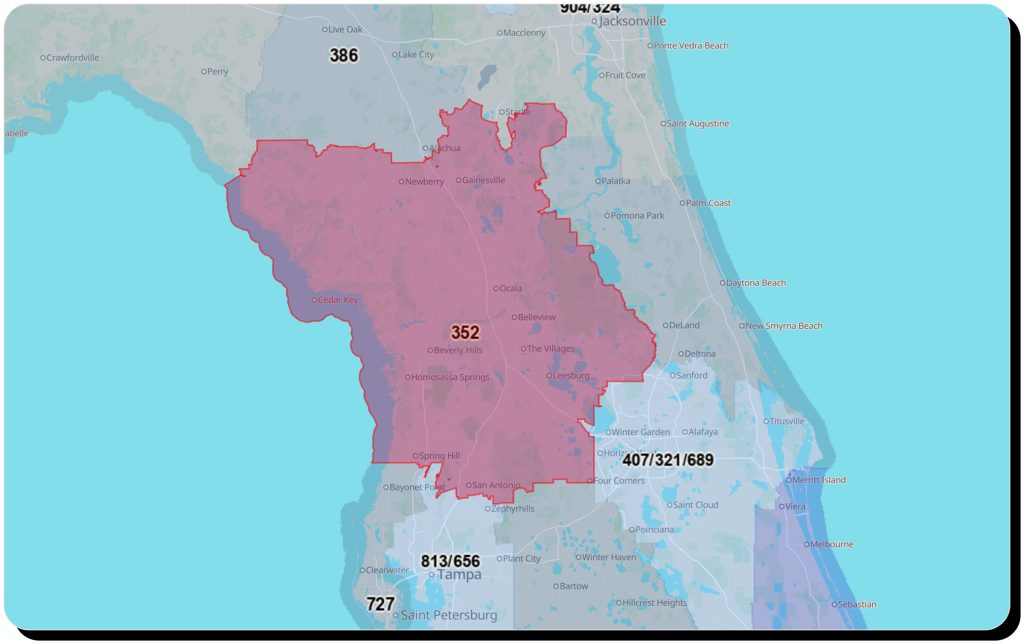
Who calls from area code 352?
Any of the area’s 1.5 million residents, or a business or organization based there, could be calling from a 352 phone number.
The problem is that scammers can also call from the 352 area code location—or make it appear that they’re doing so by means of call spoofing.
What is call spoofing, and why might people spoof a 352 number?
Call spoofing involves using Voice over Internet Protocol (VoIP) or a spoofing app to make a different phone number show up on the recipient’s end. It’s legitimately used by law enforcement personnel, journalists, sales reps, and some volunteers who staff helplines using their own phones.
So, why might someone be specifically sending you 352 area code spam—either via call or text—if they don’t live in the area? It all comes down to perceived proximity. Scammers know that people are simply more likely to answer a call (and let their guard down) if they think it’s local. In cybercrime, it’s a common tool in social engineering scams.
Scammers don’t need to stop at the area code. They can spoof the next three digits, too—a practice known as “neighbor spoofing.”
These “local presence” scam techniques can target any region, but one thing that’s particularly attractive to scammers about Gainesville is that it’s a college town with lots of young people who might not know how sophisticated today’s scams can be.
Typical area code 352 scams you might encounter
Getting hit with lots of scam calls isn’t a new experience for central Floridians. Already in 2018, people in and around Gainesville were getting 15 robocalls per month on average. 30-40% of these were scams.
It hasn’t gotten much better.
Scammers are continuing to target area code 352 residents, posing as trusted institutions, local businesses, or friends and family. In fact, just last year the Ocala police issued a warning about scam calls getting even more convincing.
There’s nothing particularly unique about area code 352 scams, text message fraud, and so forth; the fraudsters generally use the same tactics as they do with other locales. Here are a few scams you might encounter:
- Jury duty scam. Fraudsters claiming to be law enforcement officials inform the call recipient that they failed to show up to jury duty and must pay a fine immediately. This type of scam has been happening in Alachua County.
- Technology rep scam. Fraudsters may pretend to be calling from a well-known tech company (think: Microsoft), telling the recipient their computer has a virus. They’ll then try to extract payment and/or request remote access to the device to steal sensitive information and demand a ransom.
- Family member arrest scam. The recipient will be told by someone posing as law enforcement that their loved one has been arrested and needs immediate help getting bailed out of jail.
In many cases, the callers will ask to be paid in bitcoin, gift cards, or wire transfer. Recently, scammers have also been using apps with little buyer protection like Cash App and Zelle. This is an instant red flag—no real institutions, bank or otherwise, will ask you to pay in this manner.
How to tell if a 352 area code call is a scam
The first sign that you’re dealing with a scammer is an attempt to pressure you into providing either payment or sensitive personal info using high-pressure tactics and threats. Legitimate organizations will never pressure you like this.
Here are some additional warning signs to look out for:
- The call starts out as a robocall (a pre-recorded message that starts playing shortly after you answer the phone).
- The caller claims that “only you” have been selected for this “very special offer” that seems way too good to be true.
- A caller claiming to be tech support asks to remotely log into your computer, but you hadn’t previously contacted any tech support yourself.
- You’re pressured to pay up ASAP in an unusual way, such as by sending bitcoin or purchasing a gift card.
Remember that if organizations like the IRS really do need to get in touch with you, they’ll do it another way—like snail mail.
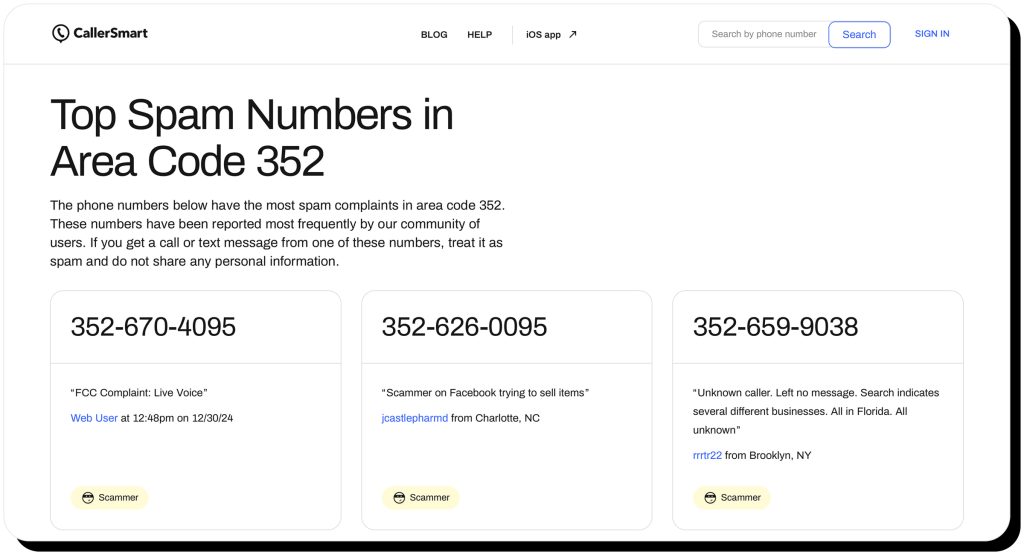
What to do if you get a spam call from a 352 number
Fraudulent calls targeting Florida residents, such as the jury duty scam, are the reason why many people don’t even bother to answer calls from numbers they don’t recognize—even if the area code is a local one. This is a wise and valid response.
If you do answer such a call, here’s what to do:
- Just hang up. There’s no reason to stay on the line with someone who’s actively trying to deceive you, and you want to avoid giving them any vocal cues they can try to clone with AI.
- Immediately after that, block the number. They’ll probably just get a new one, but every little bit of blocking helps.
- Next, dial the legitimate organization they’re trying to impersonate. Use the contact details from the official website—not the caller ID. This way, you’ll get confirmation that it was indeed a scam, and your bank or local Sheriff’s office will be informed if necessary.
- Report the call. You can report it to the Federal Trade Commission and also file a complaint with the FCC.
- If it was a text message instead of a call, forward it to 7726. The number 7726 spells out the word SPAM on the traditional phone keypad, and it helps report the accident directly to your mobile carrier.
You can get some long-term protection by signing up for dedicated apps like Robokiller or Hiya. These filter incoming calls and help prevent spammy ones from reaching you.
Ending spam calls for good: is there hope?
Both the FTC (Federal Trade Commission) and the FCC (Federal Communications Commission) have been working to mitigate this issue for quite some time. Unfortunately, scammers constantly upgrade their tactics, and they’re now taking advantage of new technologies like generative AI.
A couple of things these governmental bodies are doing:
- Increasing the fines levied against illegal robocallers.
- Requiring phone companies to implement better call authentication using the STIR/SHAKEN protocol.
- Letting phone companies use analytics to block unwanted calls from reaching consumers.
For the foreseeable future, however, protection against scam calls will rely heavily on your own awareness. Keep abreast of the latest types of fraud and avoid falling victim to the types of high-pressure tactics that these scammers use.
How Onerep protects you from spam calls
Scam callers use your own personal information to convince you that they’re the real deal—whether they’re pretending to be the Sheriff’s office, your bank, or the IRS. One Redditor’s fiancée encountered something adjacent to the jury duty scam and was shocked to hear them rattle off her entire legal name and address.
Unfortunately, it’s not difficult to find your private details online—they are easily available on people-search sites. These websites reveal such sensitive information as your current and previous addresses, contact details, family ties, place of work, estimated income, and much more. What’s worse, much of this data is often available for free, with more in-depth reports costing only a couple of bucks.
Onerep helps you regain privacy by removing your exposed data from 317 people-search websites. The service finds the pages that publish your information and requests opt-out on your behalf. After that, Onerep continuously monitors the sites to make sure your details aren’t republished—and can’t be exploited by scammers.
FAQs
What area code is 352?
Area code 352 serves Gainesville, Florida and a few dozen surrounding cities. It broke off from area code 904 in 1995.
Who calls from area code 352?
Individuals and organizations based in central Florida are all likely to call from a 352 phone number. Unfortunately, there’s a tendency for scammers to spoof this area code and make themselves appear to be local when they’re not.
How do you recognize area code 352 spam calls?
There’s no way to know for sure if a given number is spam before answering. However, if the person on the line tries to pressure you into submitting payment or providing personal info, this should raise your suspicions. Immediately hang up and call the legitimate number of the organization they’re trying to impersonate.
Mark comes from a strong background in the identity theft protection and consumer credit world, having spent 4 years at Experian, including working on FreeCreditReport and ProtectMyID. He is frequently featured on various media outlets, including MarketWatch, Yahoo News, WTVC, CBS News, and others.