 Last updated January 29, 2026
  read
read
Area code 518 spam explained: latest scam tactics and prevention tips
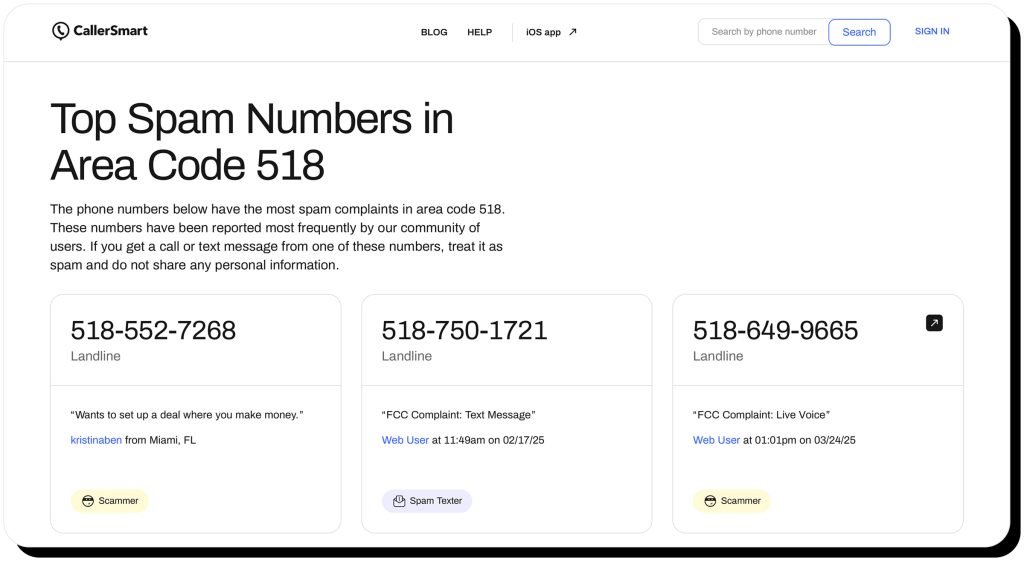
The most common area code 518 spam and scam techniques take advantage of the region’s ties to New York state government and local utilities. Popular tactics include bank impersonation calls, fake utility disconnection threats claiming to be from National Grid or NYSEG, and government-related scams involving the IRS or New York State agencies. Delivery-themed fraud—such as USPS or FedEx missed-package scams—continues to rise, especially with AI-generated voices that sound convincingly human.
To protect yourself, avoid answering calls from unfamiliar 518 numbers, never share personal or financial information with unsolicited callers, and use your carrier’s spam-blocking features or third-party call-screening apps. For text scams, avoid clicking links, verify messages through official websites, and delete anything with unusual urgency, poor grammar, or unfamiliar senders.
What area code is 518?
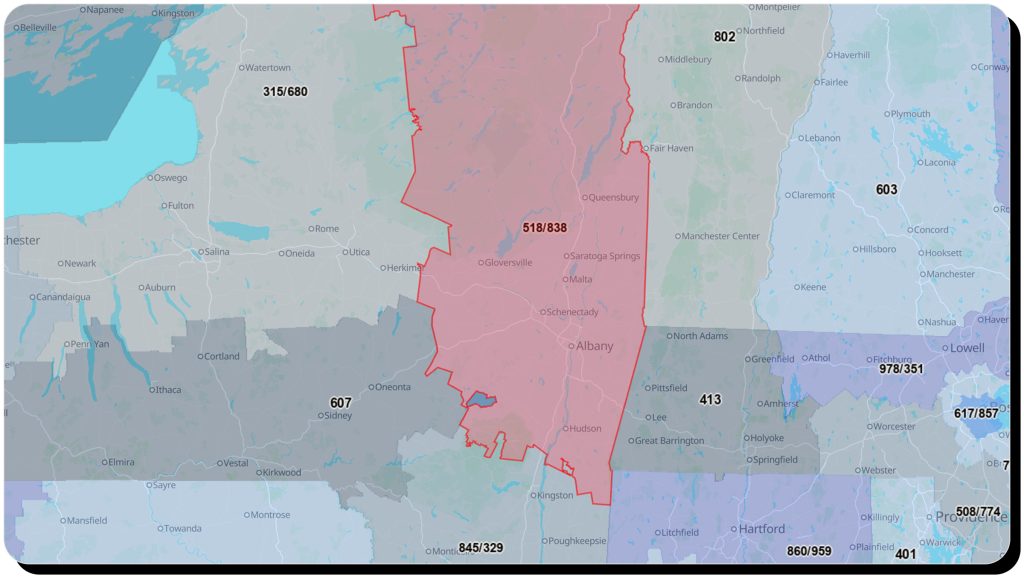
518 is one of the original area codes in the United States, representing the northeastern part of New York state. It was introduced in 1947 as part of the North American Numbering Plan, a standardized design for long-distance phone calls created by AT&T. Area code 518 covers 17 counties, including Albany, Saratoga, Schenectady, Rensselaer, Saratoga, and Washington. It serves the region alongside its overlay area code 838, which was added in 2017 to meet growing numbering demand.
Why you might receive area code 518 spam calls and texts
518 is one of the oldest and most recognizable area codes in the US. While used by thousands of legitimate people and businesses, its familiarity makes it especially effective for spoofing—people are just more likely to pick up a call that appears to come from a known location.
Moreover, modern technology doesn’t make it a hardship for spammers and scammers to disguise their real phone numbers. The most common techniques they employ are:
- Voice over Internet Protocol (VoIP): Unlike traditional phone systems, many VoIP services allow users to enter any outbound number they want, making it easy to display a fake local number—such as one from area code 518. VoIP also requires little verification and can be set up quickly with inexpensive or anonymous accounts.
- SMS gateways: These allow scammers to send text messages through online platforms rather than a physical phone, often with minimal verification as well. Many gateways allow users to set a custom “sender ID,” meaning the scammer can make a text appear as if it’s coming from a legitimate 518 number or even a well-known business.
Ultimately, scammers don’t need to physically be in the 518 area—they can use this code while being anywhere in the world. The number is only exploited to gain your trust and increase the chances of getting you to engage.
Common area code 518 spam call schemes in 2026
Financial or bank impersonation
Scammers often pose as financial institutions—like credit card companies or banks—in vishing scams. The goal is for the caller to give up sensitive information, such as their checking account details or Social Security number. They may use a spoofed ID that matches (or looks close to) a legitimate financial institution phone number, and tell you that your account has been hacked, they’ve detected some suspicious activity, or that you owe money.
Safety tips:
- Don’t share sensitive information on any unauthorized phone call.
- Hang up and dial the financial entity directly via the contacts listed on their official site to inquire whether the issue is legit.
Utility or service disconnection scams
Fraudsters may pretend to represent a utility company, such as National Grid or NYSEG. Both operate in the 518 area code, which makes them a popular target for impersonation. Scammers will create a sense of urgency by claiming your account is past due or that there’s an immediate issue requiring payment, threatening to shut off services within hours if you don’t comply. To resolve the “problem,” they instruct you to make a payment through unconventional methods like prepaid gift cards, wire transfers, payment apps, or cryptocurrency—methods that are hard to trace and impossible to reverse.
Red flags:
- Unexpected phone calls, even if the caller ID shows a seemingly legitimate business name.
- Urgency and pressure (“you only have an hour before we turn off your lights.”)
- Requests for payments via non-refundable and untraceable methods.
Fake delivery or missed-package robocalls
Robocalls have been an issue for quite a while, but Artificial Intelligence has taken them to another level, making them hard to detect. Now, not only does the voice sound like a real person, but robocalls can carry on a natural-sounding conversation.
In fake delivery scams, you’ll receive a robocall stating you missed a package, need to confirm delivery details, or must pay a small fee before the shipment can be released. The goal is to pressure you into sharing personal information or making a fraudulent payment.
Warning signs:
- A phone call from a delivery service when you’re not expecting a delivery.
- No physical notice indicating you missed the delivery or no such info in your account.
Tax or loan forgiveness calls
If you receive a phone call from someone claiming to be with the New York State Government, a federal loan agency, or the IRS, it’s most probably a scam. Several have been circulating over the years, with the most current claiming there’s an urgent issue like unpaid taxes, a pending refund, or eligibility for special loan forgiveness. They use fear or excitement to push you into acting quickly, insisting that you must verify your identity, provide banking or Social Security information, or make an immediate payment to avoid penalties or secure the supposed benefit.
Safety tips:
- Remember that government officials will never make unsolicited calls requesting personal or financial information. They also normally don’t call without first sending letters.
- Hang up immediately if someone claims that they are from the IRS, Department of Education, or a state agency and pressures you to act quickly.
- Log in to your accounts to check whether you’ve been alerted to any issues there.
- Use call-screening software from your provider or apps like RoboKiller or Hiya.
Crypto investment and “job offer” scams
This type of scam exploits the lack of regulation in the cryptocurrency industry. It usually starts with a call from a recruiter, financial advisor, or business representative. They will promise unusually high returns, exclusive investment opportunities, or high-paying remote jobs. For crypto schemes, they’ll encourage you to deposit money into a crypto wallet or trading platform they control (they’ll also typically show fake dashboards or profits to lure you into sending more). With fake job offers, they may request upfront fees for training, equipment, or application processing—via non-refundable and untraceable payment methods.
Red flags:
- Jobs or investment opportunities that are just too good to be true.
- Calls from celebrities or well-known financial figures.
- Payments required in order to apply for a job.
Common area code 518 spam texts in 2026
Package delivery or USPS text scams
These are a type of smishing scams where fraudsters claim there’s an issue with your package or an unpaid delivery fee. Such texts include a link to resolve the issue which will lead to online forms that elicit personal info or even install malware on your device.
Warning signs:
- Unsolicited text messages (USPS only sends delivery updates upon request).
- Any links included in a text message.
- Urgent language demanding immediate action or payment of “unpaid fees.”
- Typos or grammar mistakes.
Fake payment confirmations
These texts will state you’ve been charged a large sum of money—but it’s a purchase you didn’t make. The text may say something like “Your card was charged $689.99 at Amazon” to create immediate panic and push you into clicking a link or calling a fake customer support number included in the message.
Red flags:
- Alerts for charges or purchases you didn’t really make.
- Links to forms that require your financial or personal details.
- Inconsistent branding: incorrect logos, phrasing, or formatting that real companies wouldn’t use.
- Phone numbers that don’t match official ones, especially toll-free or international numbers.
Gift card or reward messages
Such texts come unexpectedly (you didn’t participate in any contest) and claim you’ve won a prize, earned a store reward, or qualified for a limited-time offer. The message will include a link to “claim your reward,” which actually leads to a phishing page. In some variations, scammers try to convince you to purchase gift cards and send them the codes, claiming it’s needed to verify your reward or complete a transaction.
Safety tips:
- Disregard requests for gift card payments from friends or family unless you expected the text.
- Don’t click links in texts that announce rewards.
- Never share gift card information or PINs.
Account verification scams
In this scenario, you’ll receive a text message from a trusted company—Apple, PayPal, Amazon, your bank, etc.—claiming your account has been locked, there’s suspicious activity, or you must verify your identity to avoid deactivation. A link in the text leads to a fake login page designed to steal your username, password, and two-factor authentication codes.
Safety tips:
- Never click the links in texts. Instead, log in via your browser or app directly.
- Ignore messages not addressed to you by your name since most legitimate services personalize their communications.
- Never text or call the number back if you suspect a scam.
Local event or store promotions
Scammers often spoof small businesses’ and local shops’ phone numbers to advertise a fake limited-time deal, free tickets, special discounts, or a local event registration. Such texts usually have a link that leads to a phishing site designed to steal personal information, payment details, or login credentials. Some versions also request a small fee for a “reservation,” “processing,” or “early access,” using payment methods that are non-refundable or difficult to trace.
Red flags:
- Spelling and grammar errors.
- Unusually generous offers.
- Multiple messages in a short time.
- Payment requests via cryptocurrency, cash apps, or gift cards.
What to do if you receive 518 spam
If you receive 518 spam, it’s important not to interact with it—ignore the call and never click any links or attachments in texts. Interacting with spam confirms that your number is active and leads to even more spam in the future.
If you’ve picked up, hang up as soon as you start feeling suspicious. It’s a good practice to avoid answering “yes” to any unfamiliar inquiries to avoid falling victim to a “say yes” scam. If you’ve clicked on a link, don’t fill out any forms and immediately scan your device for malware.
In case you believe an issue might be legit, either contact the entity in question via their official numbers or log into your account via your browser or app (never through links in texts).
If you accidentally shared personal details, alert the relevant agencies and change passwords to your accounts. You might also consider freezing your credit if the details exposed are highly sensitive like your SSN or bank account info. Keep an eye on your bank and credit accounts for suspicious activity over the next few months.
Report the fraudulent number to the FTC and your carrier, and block it on your phone. For text scams, you can also forward the message to 7726 (SPAM) to help your carrier block similar attacks.
How Onerep protects you from spam
One of the easiest ways for scammers (or any ill-wishers for that matter) to find your phone number is through people-search sites. These also reveal your full name, home address, email, estimated income, relatives, and numerous other sensitive details—often for free.
Onerep removes your personal information from 317 people-search sites, reducing your risks of being targeted with scams. The service scans the websites to find the pages that expose your data, then sends opt-out requests on your behalf. After that, Onerep continuously monitors the sites to make sure your information doesn’t reappear—if it does, new removal requests are sent immediately.
By opting you out of 317 people-search websites, Onerep reduces how easily scammers and data harvesters can access your personal info, helping protect your privacy and lowering your risk of targeted spam and fraud.
FAQs
Who calls from area code 518?
Up to 2 million people live in the 518 area code region (northeastern New York). There are also a few large companies and government institutions based in the area. Because the region is home to the state capital and numerous agencies, legitimate calls may come from government departments, universities, hospitals, and local service providers. However, many calls that appear to come from a 518 phone number are actually spoofed, meaning scammers and telemarketers may display a 518 caller ID to appear local and increase the chances that people will pick up.
Where is area code 518?
The 518 area code location is the northeastern region of New York State, often referred to as Upstate New York or the Capital Region. It covers major cities and counties including Albany, Schenectady, Troy, Saratoga Springs, and parts of the Adirondacks. It serves the region alongside its overlay code, 838.

Mark comes from a strong background in the identity theft protection and consumer credit world, having spent 4 years at Experian, including working on FreeCreditReport and ProtectMyID. He is frequently featured on various media outlets, including MarketWatch, Yahoo News, WTVC, CBS News, and others.