 Published February 9, 2026
  read
read
Is Booking.com legit? A traveler’s guide to safety and common scams
Booking.com is a legitimate company with payment security features, account protections, and consumer safeguards. That said, as a large online platform with a variety of property types available, it still carries the risks of fraudulent listings and other scams.
Travel scams shot upward in 2024, with Booking.com being at the forefront of sounding the alarm. The culprit? Generative AI technologies that make it much, much easier to set up a sophisticated phishing attack.
From phishing to fake properties, we’ll take a look at all the risks travellers should watch out for despite Booking’s legitimacy. But first, some background on the company.
How does Booking.com work?
Booking.com serves up listings on a wide variety of properties, including hotels, apartments, vacation rentals, and guesthouses. However, it doesn’t own or manage any of these: being an online travel agency (OTA), it’s simply an intermediary that connects travelers with places to stay.
The hosts are the ones who set prices and policies, while Booking.com does the following:
- processes bookings
- processes the payments completed via the platform
- facilitates messaging between guests and properties
- lets property owners take advantage of its marketing tools
Additionally, Booking.com can serve as an intermediary for booking flights, car rentals, sightseeing activities, and the like.
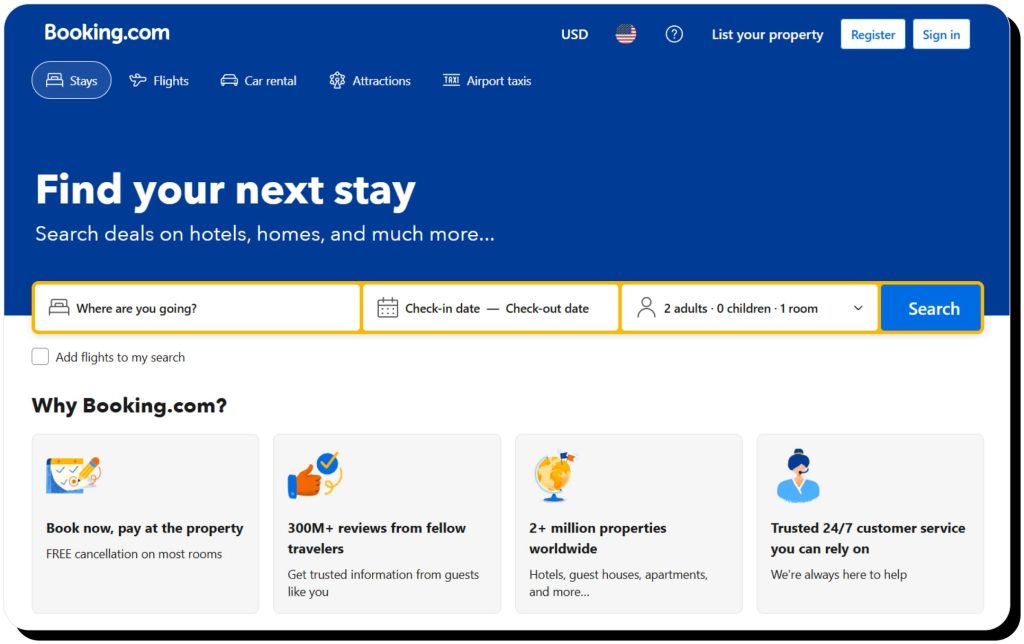
Why is Booking.com so popular today?
The company’s rise to dominance started back in the 2010s with a persistent marketing campaign. Booking.com was the top Google Adwords spender in the travel sector in 2011, and in 2013 it ran a memorable ad campaign featuring the catchphrase “Booking.yeah!”
Today, it’s known for giving customers a wide variety of options, from ordinary hotels to unconventional accommodations like igloos and houseboats. Even more important, the booking process is straightforward and easy-to-navigate with no hidden fees or terms. Rentals are required to have detailed descriptions with amenities, prices, and policies clearly listed—so that you know exactly what you’re booking before paying.
Is Booking.com safe to use in 2026?
Yes, Booking.com is safe to use, at least as much as any other legitimate online platform is these days. Booking.com is part of Booking Holdings Inc. (a US public company), which is subject to SEC reporting requirements, financial transparency and audits, and consumer protection and advertising laws. It also complies with state privacy laws and federal laws enforced by the Federal Trade Commission (FTC).
Here are some of the measures that Booking.com takes to protect renters and customers using its platform:
- Payment security features. Booking.com is PCI-DSS compliant, meaning that it adheres to the core 12 requirements for any organization worldwide that stores, processes, or transmits credit card data.
- Account security features. Users can secure their accounts with two-factor authentication (2FA) to prevent unauthorized access. Booking.com has also been implementing AI-enhanced cybersecurity measures to detect suspicious login attempts. The company states that it blocked over three million fake accounts in 2024.
- Consumer protections. Negative things still happen, but Booking.com is trying to mitigate their impact on renters and customers by providing a review system, an on-platform messaging system reviewed for spam and fraudulent activity, and 24/7 customer support.
- Booking confirmations. These contain all the information a traveler might need on a property—address, lodging type, stay dates, full price, amenities, etc.—as well as cancellation rules. Confirmations can serve as evidence in case something goes wrong.
Is Booking.com reliable (per customer opinion)?
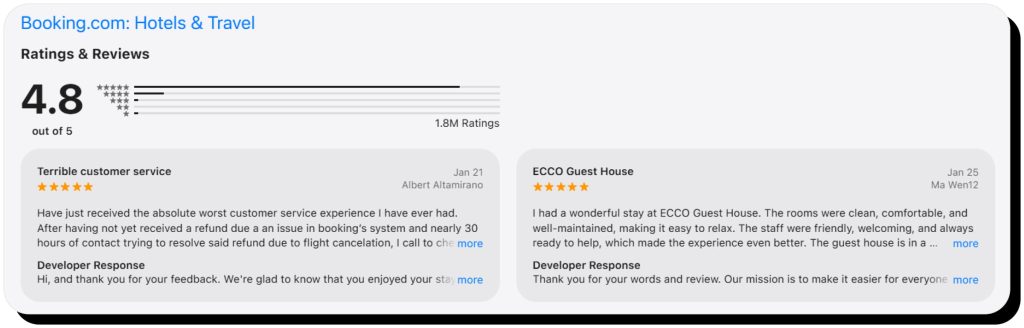
At first glance, Booking.com seems to have a mixed reputation online:
- 1.9 out of 5 stars on Trustpilot
- 1.1/5 stars on ConsumerAffairs
- 4.8/5 stars in the App Store
- 4.8/5 stars on Google Play
If you take a closer look, however, you’ll see that the platform often gets blamed for issues caused by individual hosts (that it has no control over).
Nevertheless, some complaints do point to real frustrations—especially around customer support responsiveness, refund handling, and the limits of Booking.com’s ability to intervene. Reviewers often feel frustrated when Booking.com defers to a property’s cancellation or refund policy, even in cases where the accommodation doesn’t fully match expectations. This leads some users to perceive the platform as unreliable, even though the underlying issue is usually the host or property rather than Booking.com’s booking system itself.
Overall, travelers who understand Booking.com’s role as an intermediary—and stick to well-reviewed properties—tend to report far better experiences.
Common Booking.com scams
A lot of the hassle that can arise from using Booking.com comes from scammers trying to take advantage of the platform’s popularity. Here are a few schemes to watch out for:
- Rental properties that don’t actually exist. Fraudsters will create listings using stolen photos, generic descriptions, and prices that seem unusually attractive—then vanish after the payment is processed. By the time the traveler realizes something is wrong—such as receiving vague responses, last-minute excuses, or discovering the address doesn’t exist—the scammer has disappeared, leaving the traveler without accommodation.
- Property owners trying to get money without actually hosting anyone. They do this by ignoring messages from the traveler while communicating with Booking.com itself. This makes Booking.com think the traveler is the one who’s being unreliable, despite having to seek out a completely new place to stay.
- Hosts asking you to pay outside of the Booking.com platform. The easiest way to lose Booking.com protections is to communicate and pay outside the platform. A host will request cryptocurrency, bank transfers, or gift cards, claiming it’s faster and more secure. In reality, these make the transaction nearly impossible to reverse.
- Non-refundable bait-and-switch tactics. When you arrive, you’ll find that you’ve been moved to a much less desirable lodging without any discount or refund whatsoever. The reasons given may range from “overbooking” to “plumbing issues.” If you’re not satisfied, hosts may suggest that you cancel the booking—but they won’t mention that if you do so, they’ll avoid penalties from Booking.com while you’ll be left without recourse.
- Phishing scams. You may receive a message stating that your booking will be canceled within 12 hours if you fail to provide your card number to “verify” it. In another scenario, you’ll be asked to complete a form with your personal information. The goal is to steal sensitive details that will help scammers steal your identity.
How to use Booking.com safely
Despite the fact that Booking.com is legit, you should make sure to do your own research on any place you’re considering renting. Don’t just look at ratings—read the reviews to see what visitors actually think. Also, take a look at opinions about the same place on other platforms and make sure they add up.
In addition to checking reviews, the following best practices can help you keep your bank account safe while traveling:
- Only make your payments through Booking.com’s portal. Any attempt to get you to pay another way should be treated with skepticism.
- Similarly, keep your messaging within the platform. The company uses automated scanning systems to detect malicious links and social engineering attempts within messages, but you’ll lose these protections if you move over to another messaging platform.
- Protect your account with two-factor authentication. 2FA makes it much harder for attackers to take over your account and use it to access bookings, payment details, or send scam messages in your name.
- Save confirmations and take screenshots of important communications. If something goes wrong, you’ll want to have as much evidence as possible to show that it was fraud.
- Don’t succumb to pressure tactics. Urgent requests and threats, such as “We’ll cancel your booking if you don’t verify your credit card within 12 hours,” are common phishing techniques and not a sign of a legitimate booking-related request.
- Don’t overshare. Hosts don’t need to know more about you than what’s provided during the booking process. Ignore any requests to share your phone number, ID, credit card number, and other personally identifiable information.
Whether it’s illness, accidents, or theft, there’s always some risk when traveling. However, becoming a scam victim during your much-anticipated trip isn’t a given. If you stay up to date on the latest schemes, you’ll know how to spot phishing attempts and other suspicious activity.
FAQs
Is Booking.com legit for flights?
Yes, Booking.com is legit for flights—it works as an online travel agency that partners with established airlines and licensed flight-ticketing providers to sell airfare. When you book a flight through Booking.com, the ticket itself is issued by the airline or its authorized distributor, not by Booking.com inventing or reselling flights. However, customer experiences can be more mixed than with hotel bookings, mainly because flight changes, cancellations, and refunds depend heavily on airline policies and third-party ticketing rules, which can make support slower or less flexible than booking directly with an airline.
Is Booking.com reliable for hotels?
Yes, Booking.com is reliable for arranging a stay at a hotel—as long as you do your due research on the hotel itself. Booking.com is only an intermediary and doesn’t manage any properties directly.
Is Booking.com a scam?
Booking.com is not a scam—it’s a legitimate online travel agency. Most problems people associate with “Booking.com scams” come from fraudulent listings, compromised host accounts, or attempts to move payments and communication off the platform, rather than from Booking.com itself.
Mark comes from a strong background in the identity theft protection and consumer credit world, having spent 4 years at Experian, including working on FreeCreditReport and ProtectMyID. He is frequently featured on various media outlets, including MarketWatch, Yahoo News, WTVC, CBS News, and others.