 Published March 27, 2026
  read
read
How to stay away from area code 415 spam calls, text messages, and scams
According to the FTC’s 2025 Data Book, there were 4,214 complaints from consumers who were targeted by scammers using 415 area code phone numbers in 2025.
While 415 area code is perfectly legitimate and serves the city of San Francisco along with parts of neighbouring counties, scammers take advantage of spoofing such phone numbers to steal personal information and money from unsuspecting victims.
Using the guide below, learn why and how bad actors set up their area code 415 scams, ways to stop 415 area code spam calls, and safety measures to take if you do answer such a scam call or text message.
Where is area code 415, and why scammers use it
What area code is 415? Established in 1947, area code 415 was one of the oldest original area codes serving Northern California, specifically San Francisco and the Bay area. Over the years, the 415 area code location has shrunk to the city of San Francisco, Marin County, and parts of San Mateo County, which now overlaps with the geographic area also served by area code 628, introduced in March 2015.
Since the new 628 area code was added in 2015, it has become impossible to get new numbers starting with 415. From the consumer’s standpoint, businesses with 415 phone numbers can pass off as more established and having a historic presence in the area. As one of the oldest, area code 415 carries brand recognition and perceived legitimacy. However, scammers also abuse such phone numbers for exactly the same reasons—to build trust and credibility with potential victims simply by pretending to be local and long-operating.
This area code is also attractive to scammers because it covers a high-trust geography with a strong startup community affiliation and investment context. From an economic targeting perspective, the San Francisco Bay Area can offer a high potential transaction size, especially for scammers residing overseas.
All in all, using a 415 area code phone number allows scammers to:
- Exploit the adjacency to well-known and established brands in the region
- Create a cognitive bias where familiarity equals trust
- Increase response rates
- Get a higher financial yield per target
How scammers spoof 415 numbers: the tech behind the fraud
Importantly, most scam calls don’t physically originate in the 415 area. Today, scammers frequently use the neighbor spoofing technique, using the same area codes as their targets via VoIP systems.
VoIP spoofing is a core mechanism enabling fraudsters to exploit 415 phone numbers for malicious purposes. Modern voice calls rely on signaling protocols such as SIP (Session Initiation Protocol) to set up the connection. If the VoIP provider doesn’t strictly authenticate phone number ownership, a scammer can specify any 10-digit number, including one starting with 415 or any other area code, and deliver it to the target. The receiving caller typically accepts the caller ID at face value because traditional telephony networks operate on mutual trust principles.
Reasons why carriers can’t fully block spoofing include:
- Legacy signaling infrastructure—systems designed decades ago under a trust-based model.
- Multi-hop call routing that often features international carriers and loosely regulated providers, so the final carrier can’t reliably identify the call origin.
- Blocking constraints, where excessive phone number blocking may disrupt legitimate business operations and create liability for carriers.
In the U.S., carriers use STIR/SHAKEN protocols to cryptographically sign caller ID information. However, it’s not a remedy against 415 area code spam and scam calls, as not all international carriers support it, and even authenticated calls can still be social engineering scams. While this protocol reduces caller ID spoofing, it doesn’t eliminate it entirely.
The most common area code 415 scams right now
Who calls from area code 415? With San Francisco and the Bay Area being culturally rich and economically vibrant, phone numbers typically associated with the area come from the technology, tourism, and finance industries, among others. Knowing this, spammers and scammers of all sorts jump on the opportunity to impersonate local organizations and, thriving on trust, harvest personal information or gain financially from victims.
Some of the 415 are code numbers reported in February 2026 to the FTC, include:
- 4153760509
- 4156445880
- 4156589798
- 4152004200
- 4153909689
- 4154810338
- 4159080698
- 4158592348
- 4153760509
- 4159657698
- 4155897934
The most common area code 415 scam text messages and calls generally fall into the following categories.
Impersonation scams
This is by far one of the largest categories of 415 phone number scams, featuring impostors of local businesses and government agencies.
Scammers using 415 area code phone numbers may also claim affiliation with:
- Tech companies
- Banks and financial institutions
- Tax agencies
- Law enforcement agencies
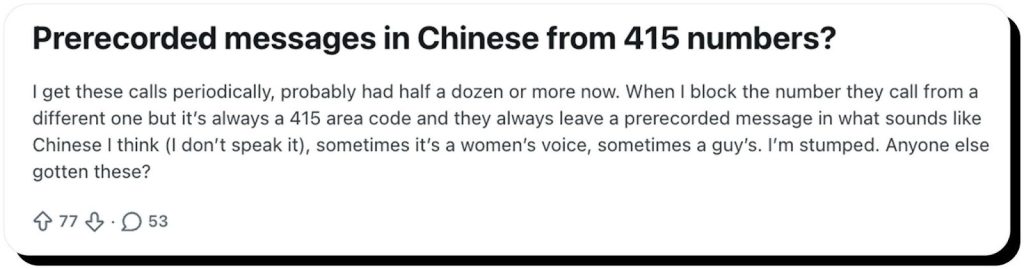
In a stream of 415 area code spam calls that dates back to 2017, robocallers left messages posing as Chinese Embassy representatives in the USA and urged recipients to share their credit card details.
In another example, the target was contacted by an Uber impersonator who intercepted an Uber delivery driver during order delivery and attempted to obtain their sensitive personal information and have money transferred via Cash App.

Loan and financial relief scams
Another significant category of 415 area code scams includes advance-fee loan and financial relief scam schemes.
In this type of scam, bad actors pose as fake loan companies cold-calling their targets and offering attractive loans on the premise that an upfront payment is required first to secure the loan. As a result, victims can lose thousands of dollars, as well as grant scammers access to their sensitive financial information.

In a variation of this scam, fraudsters set up phishing sites designed to steal personal information, luring victims to such sites via messages advertising lavish financial aid.

Job offer and recruiter impersonation scams
Common patterns in job-related scams featuring 415 phone numbers include remote job offers that don’t require face-to-face interviews, provide high pay for minimal qualifications, or use fake job listings to direct candidates to third-party services that are either paid or steal candidates’ personal information via phishing websites.
One particular 415 code phone number—(415) 376-8064—has been repeatedly identified with the Careers Flow Recruit company, which advertises fake job posts to direct candidates to a paid resume formatting service, potentially also skimming candidates’ personal information and making it publicly available in the process.

In another impersonation scam, the caller left voicemails posing as a YouTube recruiter and offering a flexible part-time job with a paid vacation, encouraging candidates to call back.
Investment and cryptocurrency fraud
Given San Francisco’s association with tech and venture capital, 415 phone numbers can be commonly used in scams where targets are offered crypto “recovery” services, investment advice, and participation in high-return trading schemes. Another potential fraud schemes you should be aware of is pig butchering—a long-haul investment scam based on a mutual trust relationship that the scammer develops with the victim over time.
415 are code scams vs spam calls
Not all 415 area code phone calls are scams with outward malicious intent. Some of them are just spam. While unwanted, 415 area code spam calls don’t necessarily involve deception, social engineering, or criminal intent, but they may still be illegal under local consumer protection laws.
415 area code spam calls, or more frequently robocalls, can feature topics such as:
- Telemarketing
- Political outreach
- Survey campaigns
- Sales pitches
- Insurance
- Financial services
Their goal is typically to generate leads and sales for a particular business (one that is legitimate rather than impersonated).
Some spam operations do evolve into scams. For example, when a spam call or text acts as an entry point for a loan scam that starts with a robocall but then develops into requests to pay an upfront fee for the provided services.
What to do if you receive suspicious 415 calls or texts
If you receive a suspicious unsolicited call from a 415 phone number, make sure to do the following to avoid getting scammed or compromising your personal information.
- Do not engage: if you can’t verify the caller’s identity or their reasons for contacting you, avoid engaging in a conversation, clicking links, sharing verification codes, calling back, or visiting their websites.
- Verify the source independently: if the caller or sender identifies with an organization or claims to be a person you know, use an independent communication channel via official or proven contact details to confirm their information. Never rely on contact details shared in suspicious calls or texts.
- Assess the red flags and treat the communication as high-risk if it involves unsolicited requests, urgency, pressure to respond or act immediately, payment requests, or requests to share personal information, third-party websites with forms to fill in, claims of law enforcement or other threats, poor grammar, or mismatched domains.
- Block the phone number directly on your phone or through your mobile carrier. You can also use third-party call-blocking apps, but they typically require permissions to access your call data. In the case of spoofed numbers, you may need to enable automatic spam filtering to stop unwanted calls. If it’s a spam text, you can forward it to 7726.
- Report the incident to the Federal Trade Commission if it’s a scam, or to the Federal Communications Commission if it’s an unwanted call or text (for example, from telemarketers) or if your own 415 phone number has been spoofed.
If you already interacted with the scammer or suspect your personal data may be at risk:
- Change passwords for all affected digital accounts, especially if you shared online banking access, and enable two-factor authentication.
- Contact your bank or payment card issuer and inform them of a suspected fraud attempt.
- If you suspect identity theft, report it to IdentityTheft.org.
How to stop 415 area code spam calls for good
If you’d like to stop 415 are code spam calls, as well as minimize the chances of being contacted by other types of scammers, incorporate the following into your routine:
- Stop answering and calling back unknown numbers. You can also silence them using your phone or mobile carrier settings.
- Enable carrier-level spam filtering. Most U.S. mobile carriers provide this option to block known fraud campaigns, flag suspicious calls, and filter robocalls before they reach you.
- Register on the National Do Not Call registry to reduce lawful telemarketing calls.
- Avoid posting your phone number publicly, such as in online classifieds, business registries, or on social media.
- Take down your personal data from public sources, such as people-search websites and data brokers aggregating personal information about millions of people. Use Onerep to check whether your personal data is available online and remove it from the internet automatically.
FAQs
What’s the 415 area code in the USA?
The 415 area code serves phone numbers in San Francisco and parts of the Marin and San Mateo counties. Established in 1947, it was assigned to new phone numbers until 2015, when area code 628 was introduced to serve overlapping areas.
Are all 415 phone numbers a scam?
No, 415 area code phone numbers also belong to legitimate organizations and individuals in San Francisco and the Bay Area. However, these numbers are frequently spoofed by scammers looking to benefit from the trust and legitimacy associated with these local numbers.
Can I block unknown 415 phone numbers from calling me?
There’s no way to block all unknown 415 phone numbers from calling you, but you can block and report them individually if you suspect they come from scammers. You can also enable automatic spam filtering via your carrier for all potential spam calls and messages or silence calls from unknown callers using your device settings.

Mikalai is a Chief Technical Officer at Onerep. With a degree in Computer Science, he headed the developer team that automated the previously manual process of removing personal information from data brokers, making Onerep the industry’s first fully automated tool to bulk-remove unauthorized profiles from the internet.