 Published September 23, 2026
  read
read

Onerep is a legitimate service that removes personal information from data brokers, covering 317 people-search sites and 559 non-public brokers. What sets it apart from competitors is that Onerep actually scans all covered people-search sites for users’ exposed records and rescans them later to verify that the records have been removed. Founded in 2015, the company is based in the United States and stores all user data on Microsoft Azure servers located in the country. Onerep is also SOC 2 Type II compliant, meaning an independent audit confirmed its data security controls.
Who owns Onerep?
Onerep is owned by Dimitri Shelest, who also serves as the company’s CEO. Shelest founded Onerep in 2015, drawing on his technical background in data aggregation to lead a team that developed the first fully automated data removal service.
He has been featured in major media outlets such as Forbes, CPO Magazine, Cybersecurity Insiders, and HackerNoon. In 2021, The Software Report named Dimitri one of the top 25 cybersecurity CEOs for his technical savvy, passion for consumer privacy, and establishing a collaborative culture that values creativity.
In 2024, a report made by KrebsOnSecurity claimed that Onerep’s CEO founded dozens of people-search firms, which is untrue. While Dimitri does have a background in data aggregation, he never founded dozens of people-search sites. As mentioned in our 2024 statement, he did at the time have an ownership stake in Nuwber, Inc. However, Nuwber was a separate business and was never part of Onerep. There was never any crossover or information-sharing between the companies.
Onerep operates independently under its own privacy and security framework, with strict controls governing how user data is accessed, stored, and used. Its security controls are also subject to regular independent SOC 2 Type II audits. The company is registered in the US, with operations and data infrastructure based in the country. The team behind Onerep is international, with employees primarily based across the US and Europe.
Is Onerep safe?
Onerep is safe because it employs rigorous security policies to protect user data within its systems and when handling data broker removals. These include Information Security, Access Control, Operations Security, and Risk Management policies, with principles such as role-based access control and least privilege.
User information is encrypted both in transit and at rest and stored on Microsoft Azure servers in the US. The company also has a transparent Privacy Policy that details how information is collected and managed.
To verify that its security controls are properly designed and operate effectively over time, Onerep undergoes an annual SOC 2 Type II audit.
As for data broker removal, the service follows a data-minimization approach designed to avoid oversharing users’ personal information unnecessarily. Onerep submits opt-out requests to people-search sites only after confirming a matching record exists, while requests to non-public brokers include only the minimum details required.
How does Onerep work?
Onerep automates the removal of personal information from data brokers, which are companies that collect and sell or publicly publish your data. Depending on how they operate, they could be divided into people-search sites and non-public data brokers. Here’s how they compare:
| Broker type | How they operate | Data they collect | Examples |
|---|---|---|---|
| People-search sites | Publish your information on their sites and make it accessible to everyone. Many share some details for free, then charge a fee for an in-depth report about you | Is mainly scraped from public records, social media, and other publicly available sources. Includes your name, DOB, addresses, contact details, relatives, legal records, licences, and much more | Spokeo Whitepages TruthFinder |
| Non-public data brokers | Sell your information to businesses, advertisers, and other third-party organizations. Can’t be accessed by average individuals | Is gathered from public records and your online activity. Typically goes broader than what’s found on people-search sites and may include demographics, interests, income, and buying behavior | Experian Equifax Acxiom |
Onerep covers both types: all plans include 317 people-search sites and Pro plans add 559 non-public data brokers, bringing the total number to 876 websites.
However, the removal process differs.
Removal from people-search sites
Once the account is set up, Onerep scans covered people-search sites for user information. All plans allow adding unlimited name variations, addresses, phone numbers, and email addresses, so the service can find more matching records, including the ones sharing outdated details. Then, Onerep sends removal requests and follows up on them until they’re honored. Unlike some competitors that rely on brokers’ responses or removal timeframes, Onerep rescans people-search sites to verify that the records are gone.
However, the service doesn’t stop even after a successful opt-out. Data brokers regularly update their databases and publish new profiles or enrich existing ones. To catch new exposures, Onerep runs monthly scans and automatically initiates removal requests for any new records it finds.
Users stay informed every step of the process: personal dashboards list the people-search sites that expose data and provide an individual status for each one (opt-out requested, verifying removal, removed). The dashboards also contain links to pages with exposed records and some of the details found on each website for further transparency.
Lastly, Onerep handles the whole process—users don’t need to reply to verification emails from brokers or interact with them in any other way.
Removal from non-public data brokers
Since non-public brokers aren’t publicly available, there’s no way to scan them and see if they have your information. Removal typically requires actually providing your personal details so that brokers can locate your records in their databases.
To avoid oversharing and prevent unethical companies from enriching their databases with information they didn’t previously have, Onerep submits only the minimum details required by each site. For example, if a broker only needs your date of birth and name, Onerep won’t share your phone number or home address alongside it.
Acknowledging that some people may be uncomfortable sharing their information without being certain a site has it, Onerep deliberately created separate Pro plans that include non-public data brokers. Instead of mixing broker types on all plans like some services do, Onerep gives users full control of their information and lets them decide what websites to cover.
How long does data broker removal take?
It’s important to understand that removal time depends on data brokers. Processing times vary widely, from just a few hours or days to several months, with some websites ignoring requests altogether. Even privacy laws like CCPA typically give companies 45 days to respond to consumer privacy rights requests, with a possible 45-day extension. However, most US states don’t currently have comprehensive privacy legislation—there, data brokers aren’t obliged to remove your information at all.
To set expectations, Onerep provides an estimated removal time for each broker in user dashboards. However, exact dates cannot be guaranteed—just like they cannot be guaranteed by any other data removal service. What sets Onerep apart is that it continues following up until opt-out requests are honored. Users can see how many attempts have been made in their dashboards as well.
Additional features
All Onerep plans include data breach monitoring that checks if your email address has been exposed in known data breaches. Users can add up to 20 email addresses and will receive alerts if any are found leaked, along with data breach details and recommended actions.
Pro plans also include unlimited custom removal requests. If personal information is found on a data broker not covered by Onerep, users can submit the URL in the dashboard, and Onerep’s experts will handle the removal.
What Onerep doesn’t do
Onerep is a data removal service operating in the US. It focuses on what it does best: removing your personal information from data brokers. Supporting its goal of helping you identify potential privacy and security risks, the company also includes data breach monitoring on all plans.
Onerep is not an identity theft protection service or cybersecurity software, and it doesn’t advertise to be one. Onerep doesn’t offer identity theft insurance, credit monitoring, VPN, a password manager, or similar features.
Does Onerep cost money?
Onerep is subscription-based, with monthly and yearly plans available. However, all plans come with a 5-day free trial and a 30-day money-back guarantee. If you decide it’s not for you, you can request a refund within 30 days of your initial purchase.
Onerep offers several pricing tiers for individuals and families of up to six people.
Standard plans include removal from 317 people-search sites and data breach monitoring.
Pro plans include everything in standard plans and add removal from 559 non-public data brokers (for a total of 876 sites covered), priority customer support, and unlimited custom removal requests.
All plans feature monthly people-search site scans, monthly email reports, and allow you to add unlimited aliases, phone numbers, and addresses to ensure a comprehensive scan for your data. Here’s how Onerep’s pricing breaks down:
| Individual | Family | Individual Pro | Family Pro | |
| Monthly Billing | $14.95/mo. | $27.95/mo. | $29.95/mo. | $55.95/mo. |
| Annual Billing | $99.96/year ($8.33/mo.) | $180/year ($15/mo.) | $191.40/year ($15.95/mo.) | $359.40/year ($29.95/mo.) |
How to cancel Onerep subscription?
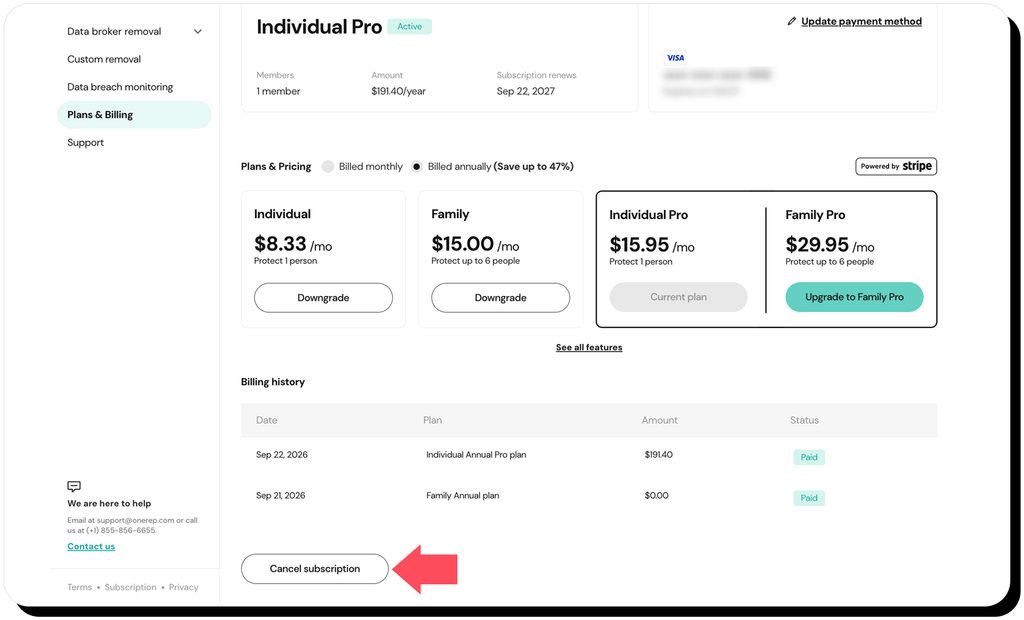
You can cancel the subscription right through the dashboard—no need to contact a representative. Simply open the Plans & Billing page in your account, click “Cancel Subscription” at the bottom of the page, and follow the prompts.
In case you run into issues, the customer support team is ready to help by phone at (+1) 855-856-6655 or by email at [email protected].
What third parties say about Onerep
Overall, the company has positive reviews on well-known platforms like Trustpilot, where Onerep has a 4.7-star rating from over 500 reviewers. Trustpilot reviewers report an “overwhelmingly great experience,” responsive and helpful customer support, and effective data removal. Onerep also boasts an A+ Better Business Bureau rating and, at the time of this writing, a 4.4-star rating on Google.
Media outlets such as TechRadar also have high praise for the company, stating they would “recommend Onerep to anyone seeking a reliable data removal platform.” Security.org called Onerep a top-tier data removal service for anyone looking to improve their personal digital security.
That said, a few Onerep complaints note that some removals take several months to complete. As previously mentioned, the removal timeline depends on each data broker’s internal process, and no data removal service can guarantee a specific removal date. What Onerep does to leverage the situation is follow up on each opt-out request until it’s honored—informing users about the number of attempts along the way.
Some users have complained that the service can only be canceled by phone, with the rumor still circulating in 2026. However, that is not the case—you can cancel directly through your dashboard, with the support team available by phone or email if you run into issues.
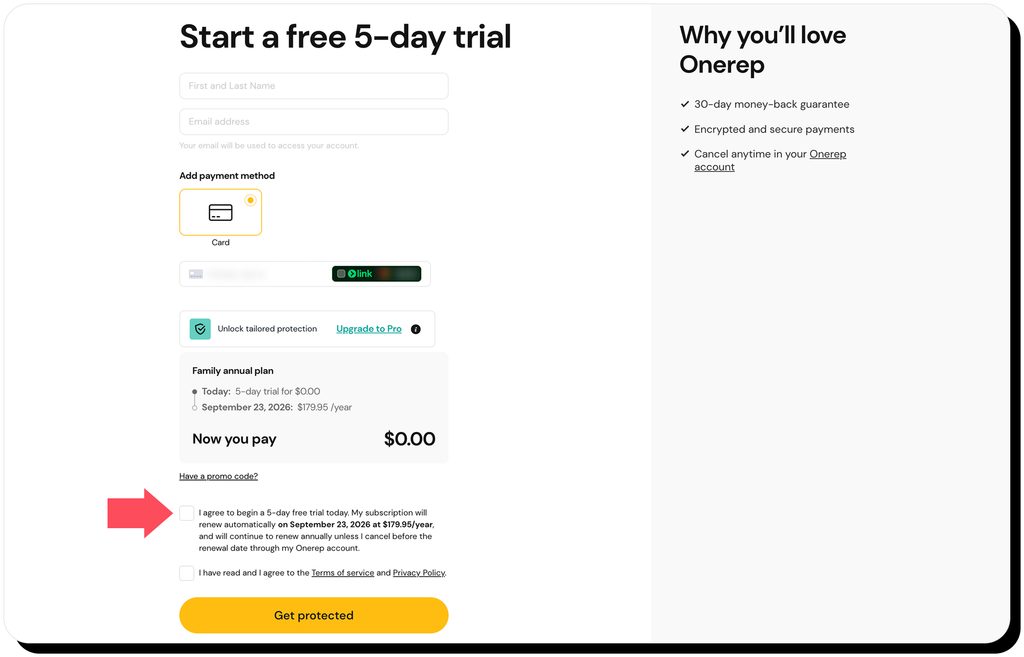
Another common complaint is unexpected charges, particularly after a trial period. To prevent such cases, Onerep provides the date when a user will be billed during sign-up. The service also explicitly states that you are charged if you don’t terminate a subscription after the trial ends, as well as gives instructions on how to cancel a subscription in its Terms of Service and Subscription Terms.
How to contact Onerep support?
Onerep offers multiple support options, including:
- Live chat
- Contact form
- Phone: (+1) 855-856-6655
- Email: [email protected]
- Mailing address: 1750 Tysons Blvd., McLean, VA, 22102
Are data removal services worth it?
Data removal services help protect your privacy and identity by keeping your personal information off data broker sites.
People-search websites publish sensitive information such as your home address, date of birth, family member names, legal records, place of work, and other details that make it easy for anyone to research you – and find you – online.
While there are some legitimate reasons to use people-search sites, such as reconnecting with old classmates or long-lost relatives, they can also be used for nefarious purposes:
- Scammers can use your personal details to create convincing phishing emails or impersonate organizations you’re associated with
- Identity thieves can impersonate you to gain access to your online accounts, including your bank accounts, and steal your money
- Healthcare benefits scammers could piece together enough personal details to claim medical care in your name
- Stalkers or ill-wishers can find where you live and work
Non-public data brokers do not publish your information online, but they do share it with advertisers, marketing companies, insurance firms, and a whole host of other organizations that can bombard you with telemarketing calls and spam emails, contribute to social profiling, and use your data to make decisions about you without your knowledge.
While you certainly can opt out of data broker sites yourself, the process is time-consuming and tedious. On top of that, your information doesn’t stay gone forever—brokers republish data as they update their databases. Companies like Onerep automate the ongoing opt-out process, saving you hours of manual work by finding your exposed records, requesting their removal, and running recurring checks for new exposures.
Ultimately, data removal services are a valuable tool in maintaining control over your personal information and limiting how widely it circulates online.
However, data removal services also have their limitations. No service can guarantee the removal of your records—that depends on broker sites. Nor can they erase your information from social media, news outlets, blogs, public records, and government sites.
Ultimately, it’s up to you to decide whether data removal services are worth it for you and your family. If your digital footprint is minimal or you’re not concerned about your information being exposed online, you probably don’t need one. But if you search for your name and find your profile on dozens of sites, if you want to cut down on spam and scams, or if you want to protect yourself against the growing threat of identity theft, data removal services might be a good investment in keeping your personal info safe.




Mikalai is a Chief Technical Officer at Onerep. With a degree in Computer Science, he headed the developer team that automated the previously manual process of removing personal information from data brokers, making Onerep the industry’s first fully automated tool to bulk-remove unauthorized profiles from the internet.