 Published February 18, 2026
  read
read
Why do scammers want gift cards? The economics behind a persistent fraud tactic

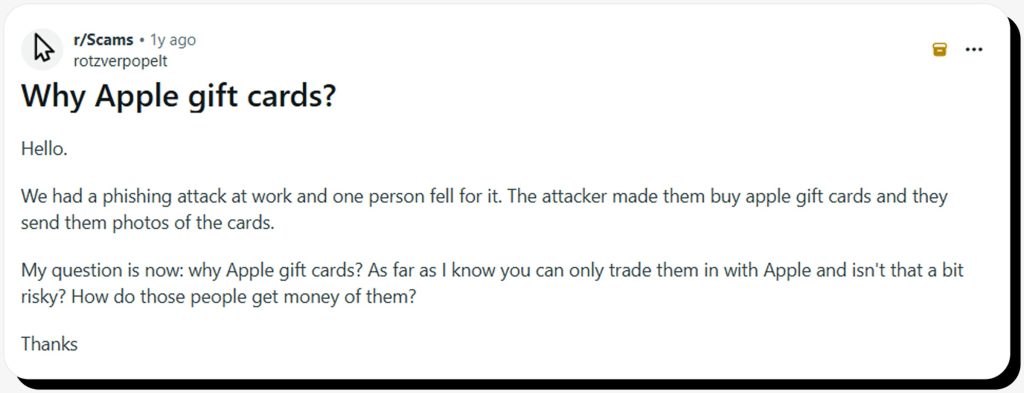
Many scammers prefer gift cards over credit cards, wire transfers, and other types of payment, in large part because gift cards shift risk from scammers to their victims. While credit card transactions are monitored for fraud and easy to track, gift cards are difficult for victims to recover and far harder to reverse than bank or credit card transactions. Sophisticated scammers will even tamper with in-store gift cards to drain their balances before they can be used.
In fact, Americans lost $250 million to gift card scams in 2024 alone, and from 2019 to 2023, criminals stole over $1 billion through gift card draining schemes.
Why gift cards are ideal for scammers
Gift cards make it easy for scammers to steal money without getting caught. Here’s why:
- Minimal oversight: Unlike banks and credit cards, gift cards aren’t centrally monitored and don’t have chargeback protection.
- Anonymity: Gift cards typically are not tied to a certain person, so anyone can use them without being identified – including scammers.
- Irreversible: Even if suspicious activity is discovered, it’s usually too late to get your money back.
- Wide availability: Gift cards can be purchased at just about any supermarket, and they’re accepted at stores both online and offline.
- Easy liquidation: Scammers can use gift cards to buy physical or digital goods, or they can quickly sell them for cash or use them to buy cryptocurrency.
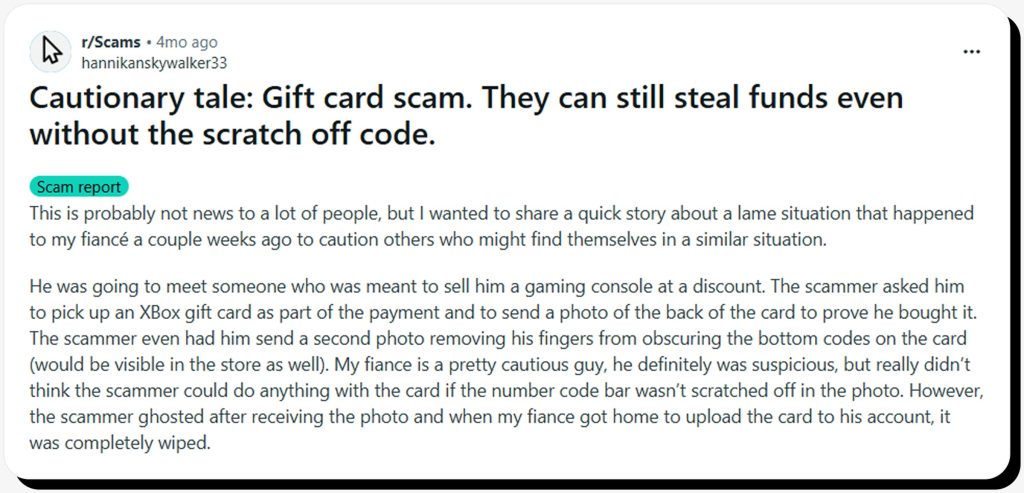
- No need to meet: Criminals only need their victims to share gift card numbers and PINs, not hand them the actual physical cards. They often use social media and messaging apps to get digital gift card codes instantly.
- Easy to scale: Relatively small gift card amounts ($50 to $500) from multiple victims can add up fast without raising suspicion like large financial transfers.
- Social engineering: Since there’s no need to meet, it’s easier for scammers to employ social engineering tactics to gain victims’ trust and coach them through buying gift cards.
- Delayed detection: Many victims don’t realize they’ve been scammed until after their gift cards have been redeemed and the scammers are long gone.
Basically, gift cards are very similar to cash. Ownership depends on who presents the card or code, not identity, making it easy for criminals to spend or sell gift cards anonymously. And like cash, once gift cards are spent, they’re gone.
Why gift cards shift risk away from scammers and onto victims
To scammers, one of the most appealing aspects of gift card scams is that they shift risk to their victims.
First, there are no chargebacks, and transactions are final as soon as purchases are made. That means victims have little to no chance of recovery once the code is shared.
Scammers are anonymous, so victims and retailers can’t determine who robbed them once they realize they’ve been scammed. Identifying criminals becomes even more difficult after they resell gift cards.
Moreover, international scammers fall outside of U.S. law enforcement jurisdiction, and low-dollar, non-bank frauds aren’t likely to attract the FBI’s attention or get cooperation from foreign agencies.
Finally, the burden of proof falls squarely on victims, who might face a difficult claims process with little chance of getting their money back. Retailers – not banks – control gift card dispute decisions, and they are unlikely to honor the same gift card twice without a reliable way to recover their losses.
Gift cards vs crypto vs wire transfers
Compared to cryptocurrency and wire transfers, gift card scams are faster and lower risk.
- Crypto: Transactions are recorded on public blockchains, and funds held on regulated exchanges are subject to Know Your Customer (KYC) requirements and potential freezing.
- Wire transfers: Bank oversight, account verification, and ID checks deter scammers who thrive on anonymity.
- Gift cards: No chargebacks, minimal oversight, and can be purchased and spent instantly without proving identity. There’s also no learning curve for victims like there can be with crypto and wire transfers.
Essentially, cryptocurrency and wire transfers put scammers at a much greater risk of being stopped, identified, and caught than gift cards do. And even if they do get away with it, wire transfers are easier to reverse if caught quickly, leaving scammers with nothing to show for their efforts.
What do scammers do with gift cards?
Scammers love gift cards for speed and instant value, not long-term holding or wealth-building. Once they have gift cards, they immediately:
- Resell them through secondary or underground markets, often at a discount for fast cash (online gift card exchanges and peer-to-peer selling platforms make it easy to sell gift cards quickly).
- Redeem them for physical goods or digital credits.
- Convert them into other assets, such as paid online accounts (games, software, or subscriptions), prepaid balances, or crypto (indirectly).
In the case of gift card draining, scammers use software to constantly monitor balances. As soon as a card is loaded with funds, they drain it. This type of automation demonstrates how gift card scams aren’t limited to one-off scammers but can be part of larger organized crime rings.
Why do gift cards remain effective despite public warnings?
Gift card scams remain effective despite warnings from the Federal Trade Commission and other organizations because scammers often exert urgent emotional pressure on their victims.
Their tactics include impersonating government agencies like the IRS and telling victims they must immediately pay a fine or go to prison. They can even use voice-cloning technology and pretend to be a loved one who is in trouble and needs funds right away. It’s easy for victims to forget or ignore warnings when under that kind of duress.
In fact, scammers often target vulnerable populations or those who are facing stressful circumstances, including senior citizens, job seekers, immigrants, and business employees. They prey on individuals they know are more likely to fall for their scams.
In addition, gift card scams exploit consumer trust in familiar brands like Steam, Apple, Target, Amazon, and Walmart. Using well-known brands’ gift cards as currency doesn’t seem out of the ordinary to many victims.
For scammers, gift cards consistently outperform alternatives like crypto and wire transfers in success-to-risk ratio. In one real-world incident, a man purchased 20 gift cards for charity, only to find that seven of them had no balance – representing a 30% success rate for scammers in that particular case alone.
FAQs
Are gift cards traceable?
Gift cards can be traced to some degree, but not in the same way credit cards can. That’s because gift cards are not linked to any specific person, so purchases made with them can be anonymous. Even though issuers can see when cards are activated and redeemed – and in some cases, a user’s IP address if they went online to check the balance (though that can be masked) – they can’t necessarily prove that the person who used the gift card did so illegally. That’s a big reason why scammers use gift cards in the first place.
What is gift card draining?
In gift card draining scams, thieves tamper with physical gift cards on store shelves. They’ll open them, jot down the numbers and PINs, then seal them back up. Alternatively, they’ll place fake barcode stickers on them. Then, bots monitor the cards until they’re purchased. As soon as they’re loaded with funds, the scammers drain the gift cards.
How do scammers cash out gift cards?
Scammers cash out gift cards in various ways, including using them to buy physical products or digital goods, selling them on secondary markets or the Dark Web, and converting them into other assets such as apps and games.




Mark comes from a strong background in the identity theft protection and consumer credit world, having spent 4 years at Experian, including working on FreeCreditReport and ProtectMyID. He is frequently featured on various media outlets, including MarketWatch, Yahoo News, WTVC, CBS News, and others.