 Published October 30, 2025
  read
read

Remote work has become the new norm since 2020, and it’s rarely a red flag today when an employer advertises a work-from-home position.
As of Q1 2024, almost 25% of U.S. workers aged 25 and older were working remotely, according to the U.S. Bureau of Labor Statistics. Many offices are now distributed, with colleagues only telecommuting via online conferencing tools and messengers.
But work-from-home job offers are also an ideal excuse for scammers to bear no responsibility for their actions, as they never have to see you face to face. This gives rise to multiple forms of work-from-home scams, where candidates are tricked into giving away either money or personal information.
This article will explain if work from home is legit and will walk you through the common types of remote work scams, along with ways to protect yourself.
What are work-from-home scams?
Work-from-home scams are fake job offers disguised as legitimate remote job opportunities, made by fake recruiters of non-existing companies or impersonators of well-known brands. The ultimate goal of such scams is to recruit people into unknowingly partaking in fraudulent activities, such as acting as parcel or money mules, sending their own funds to the scammers, or giving away sensitive personal information that could be exploited.
How to know if a remote job is legit
How do you know if a work-from-home job is legitimate? Generally, there are many legitimate remote jobs advertised by reputable companies, so look for the following signs to know you can trust the potential employer:
- The job offer is solicited: you find the vacancy openly advertised on public sources and apply using a standard job application procedure. Or, the company reaches out in response to your CV that you uploaded to a job board or sent to the company.
- The job doesn’t seem too good to be true: it requires reasonable qualifications taking into account the required responsibilities, and the advertised pay is on par with market benchmarks.
- You can easily find information about the company, for example, on the Better Business Bureau, and verify the recruiter’s affiliation with the company via LinkedIn, their work email, or other professional credentials.
- The company communicates via its official channels—an official phone number, a work email with a domain that matches the company’s website, its official LinkedIn profile, or a job board messenger. There are no unsolicited messages on WhatsApp or Telegram.
- The company takes you through a formal screening and interview process. If they’re ready to hire you without an interview or without validating your professional credentials with key stakeholders, it’s an extremely suspicious job opportunity.
- The company doesn’t ask you to pay for anything—training, equipment, or any other costs allegedly related to your job responsibilities. Employers cover these costs themselves, and no legitimate company will ever send you a check to buy your own work equipment.
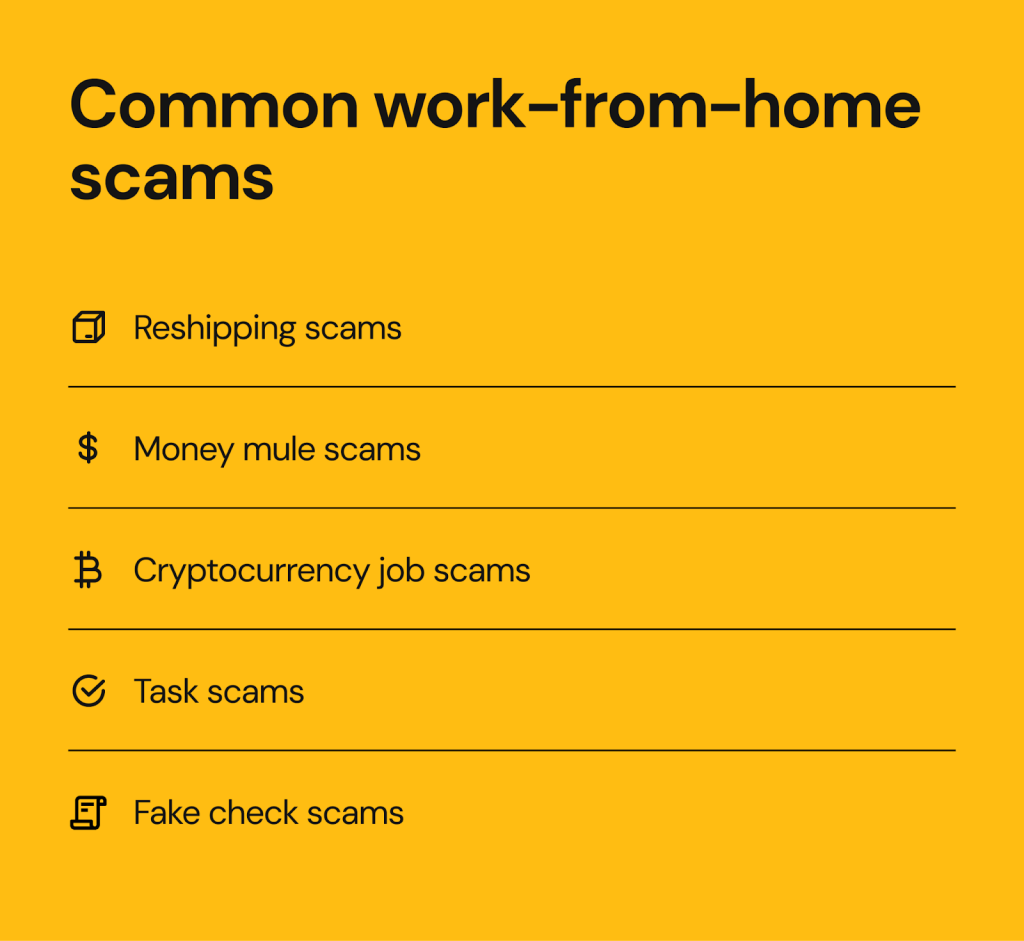
Most common types of work-from-home scams
Remote job scams come in many forms, but they all boil down to attempts to defraud candidates of money, exploit their services for free, or steal their personal information for identity theft.
Reshipping scams
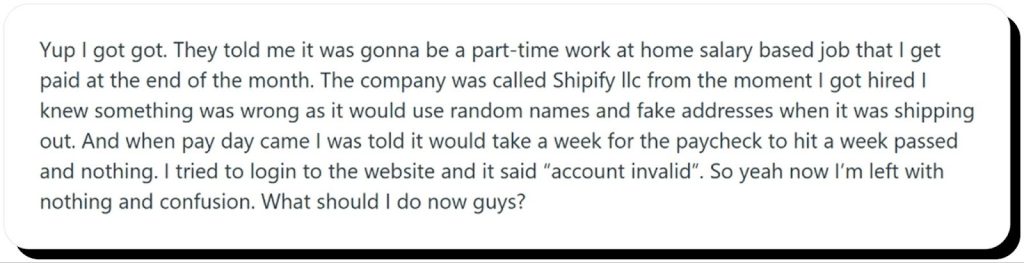
In reshipping scams, or parcel mule scams, people get “employed” by scammers to receive packages at their home address and reship them internationally. What these “employees” don’t know is that these packages hide fraudulently obtained high-value goods bought with stolen credit cards or hacked bank accounts.
These fraudulent job opportunities are often advertised as “handling packages” or “wrapping gifts” from the comfort of one’s home, promising high weekly pay and bonuses per shipped package. Of course, the “employee” is unlikely to be paid but is very likely to get into legal trouble for committing a felony by cooperating with scammers and dealing with stolen goods, even if they knew nothing about the origin of the packages.
Money mule scams
Similar to reshipping scams, people get exploited as money mules who are asked to receive funds in their own bank accounts and then transfer them to scammers’ accounts for a commission. Such fake job offers often include requirements to obtain cryptocurrency and send it to the provided wallet, which is the scammers’ way of laundering stolen funds through a third party (the scam victim). By agreeing to money mule jobs, you may be unknowingly financing illegal activities such as drug and human trafficking.
Cryptocurrency job scams
These scams involve online-only jobs from scammers pretending to be legitimate employers at cryptocurrency companies, such as crypto trading platforms or representatives of other crypto investment schemes. In addition to “training,” such jobs typically require investing personal funds into the cryptocurrency platform promoted by the scammers. While the “employee” can successfully withdraw profits initially, over time this requires increasingly large deposits until it becomes impossible for the victim to recover their investments.
Task scams
Task scams are a variation of remote job scams where the candidate is asked to complete fairly simple tasks, like boosting a product or an app on a marketplace. These scams typically start on messengers as a sort of WhatsApp scam and frequently offer payments in crypto. According to the FTC, task scams accounted for almost 40% of all job scams reported in 2024.
Once the “employee” starts doing the task, they might get some initial remuneration but are then asked to spend their own money on the product or app in exchange for larger payouts in the future. Needless to say, these payouts never come through, but the scammers may get hold of your credit card data and personally identifiable information in the process, which they use for financial fraud and identity theft. In some task fraud schemes, scammers ask victims to deposit their own funds first before they can withdraw any profits.
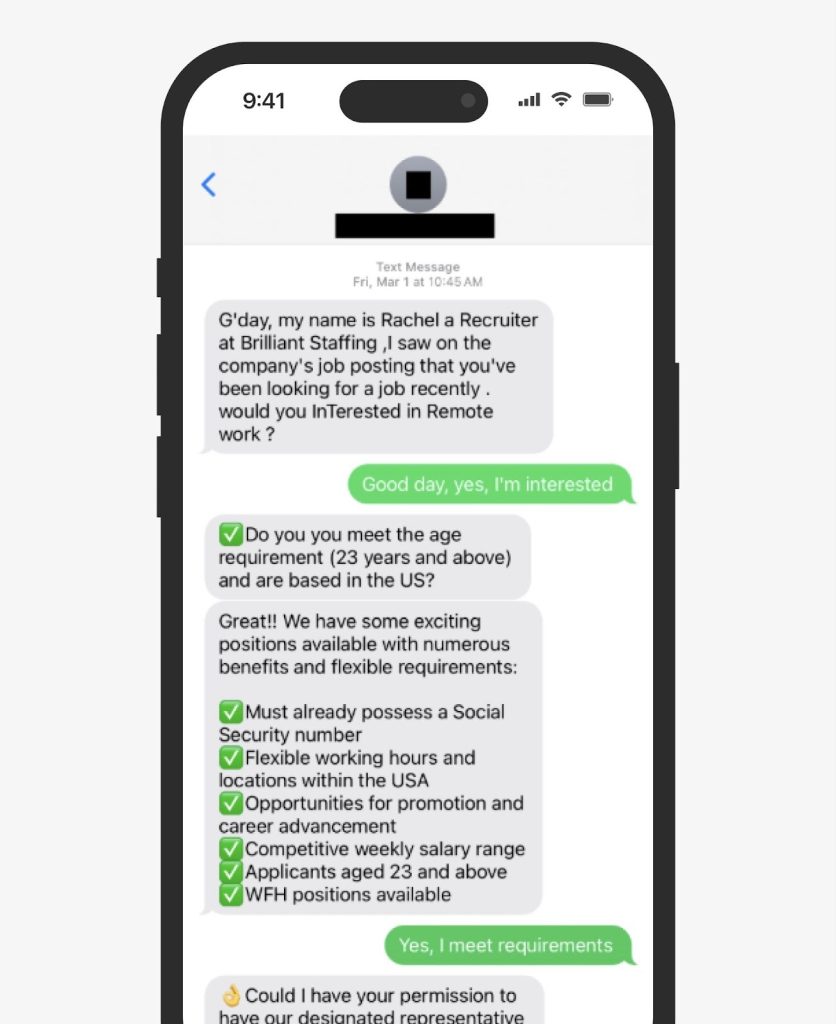
This is just one example of a message that fake recruiters use to pull victims into their task scams:

Fake check scams
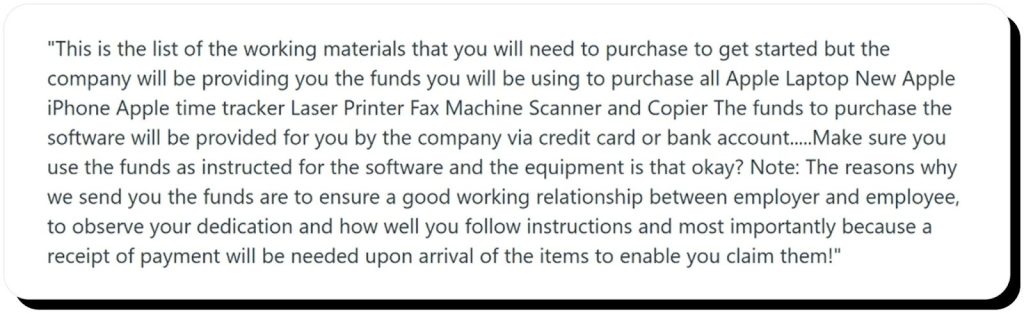
One of the most common work-from-home scams involves asking candidates to pay upfront for training materials, equipment, or certifications using the check that the “employer” promises to send. This typical scenario involves fake checks that bounce after some time, leaving the victim paying for the purchases with their own funds.
The trick is that scammers also send a check for a bigger sum than necessary, asking the victim to send the difference back using a different payment method, like a wire transfer, Zelle, or another instant payment app. As a result, the scammers will get real funds in their account, leaving the victim at a net loss.
Real-life examples of work-from-home scams
In one recent case, a lawsuit was filed in New York to recover over $2 million worth of cryptocurrency stolen from people scammed by fake remote employers.
The victims were told to participate in “market data generation” by reviewing online products but maintain a cryptocurrency balance equal to the price of the products, while unknowingly transferring stablecoins to the scammers’ accounts.
The scam started as text messages to those looking for remote job opportunities and snowballed into a massive fraudulent scheme, with victims losing as much as $100,000 individually.
In another case, the victim of a task scam was exploited as a money mule, transferring $20,000 into the scammers’ accounts via Coinbase. She was initially hired to do “app optimization” but was then required to move money between accounts in exchange for a commission. In reality, the money went straight to the scammers, who used the scheme to transfer funds stolen from other victims.
Not all scam attempts end with victims losing money, however. This case shows how important it is to recognize the red flags in time, as well as to trust one’s instincts and do background research to verify the information.
A copywriter looking for a remote job was caught off guard by a scammer impersonating a known company’s recruiter, conducting a completely text-based interview, and asking her to purchase a range of “work equipment,” including irrelevant devices, which the “company” promised to reimburse later. The copywriter contacted actual company representatives on LinkedIn and was able to validate her concerns and confirm that the offer was a scam.
How to protect yourself from work-from-home scams
It’s easy to see why people looking for a job fall for any highly promising opportunity that comes their way. The thing is, these lucrative offers are often bogus jobs posted by scammers to lure in their victims. Here’s how to make sure you avoid such fake remote job traps:
- Don’t assume the job is real because you found it on platforms like Indeed or LinkedIn. Scammers post fake ads there too, and LinkedIn scams are quite common. If you find a fake job posting, report it to the platform.
- Research the employer: legitimate companies have official websites and publicly available information about them, including past employees’ reviews. If it’s an obscure company name that can’t be googled, it’s probably a scam.
- Only apply for a job through official channels. Don’t respond to unsolicited job offers sent on WhatsApp, Telegram, or Signal.
- Search the job title and company name + “scam” online to see if others have reported it before.
- If the offer seems too good to be true, such as paying exorbitant salaries and providing 20 days of paid vacation for 2 hours of work a day, ignore it. It’s most probably a scam.
- Never pay to get paid: that’s the golden rule of avoiding online job scams.
- Never share your personal information, including the national ID and identity documents, with those posing as employers until you verify their legitimacy.
What to do if you’ve fallen for a work-from-home scam
- Stop interacting and sending money to the scammer immediately.
- If they sent you a check to clear, don’t do it—the check is forged and will bounce, making you cover the negative balance with your own funds.
- Report the scam to your local anti-fraud agency, such as the FBI’s Internet Crime Complaint Center in the U.S. or Action Fraud in the UK. Include all available information about the scam, such as the scammer’s contact details and any financial transaction information.
- If you shared your bank account details or credit card data with the scammers, contact your bank or credit institution to notify them about the scam and set up fraud alerts. In certain cases, they may be able to freeze and reverse the transactions as fraudulent ones if you transferred money from your bank account.
- If you shared any personally identifiable information with the scammers, such as your Social Security number, national ID, or driver’s license, report the scam to IdentityTheft.gov and subscribe to an identity protection service to monitor for potential identity theft continuously.
- If you lost money in a work-from-home scam, engage your local law enforcement agency.
- Learn how to protect your identity going forward by guarding your personal information, removing it from publicly available sources using services such as Onerep, and educating yourself on common scam signs.
FAQs about work from home scams
Are there legitimate work-from-home jobs or are they all scams?
Not all work-from-home jobs are scams—many are perfectly legitimate. These include positions in tech, creative industries, customer service, and business development. However, scammers exploit the demand for remote jobs to defraud people, so exercising due diligence when job hunting is highly advised.
How can I tell if a remote job posting is fake?
Some of the warning signs of a fake remote job include vague job descriptions, high pay for little work, requirements to pay upfront for equipment or training (“pay to get paid”), and interviews that only happen via text in messengers.
How can I report a work-from-home scam?
In the U.S., you can report a remote job scam to the Federal Trade Commission, the Internet Crime Complaint Center, the Better Business Bureau, and your local law enforcement agency if any financial harm or identity theft has occurred.
Why do scammers target remote job seekers?
As many people are looking for flexible remote jobs, scammers exploit this opportunity to set up low-cost, high-reward scams without having to deal with victims in person, while being able to disappear without a trace later.
Are work-from-home scams illegal?
Yes, work-from-home scams are illegal and are considered cybercrimes and felonies, all punishable under state and federal law. Anyone running or participating in such scams can face criminal charges.




Dimitri is a tech entrepreneur and founder of Onerep, the first fully automated data removal service. Top cybersecurity CEO of 2021 by The Software Report.