 Published February 17, 2026
  read
read
What to do if someone uses your address without permission: risks, signs, and how to stop it
Have you received someone else’s parking ticket? Or does an online platform seem to think that somebody else is living at your address?
Accidents happen all the time. There is always a chance of receiving unwanted mail by mistake. But in some cases, address misuse is intentional and may violate state or federal laws.
In this article, we’ll discuss the legal aspects of address misuse and fraud, pinpoint the warning signs, and break down what to do if someone uses your address without permission. You’ll also learn what steps you can take today to reduce future exposure.
Is it illegal to use someone else’s address?
In the US, it’s legal for personal information, such as a home address, to be publicly accessible. But is it illegal to use someone else’s address? That’s where things get more complicated.
The legal stance on using someone else’s home address largely depends on how and why it’s used. For example, are you staying with a friend and need to have a package delivered to their place? That’s generally not an issue. Did someone allow you to register a business at their location? If so, receiving mail there is typically permitted.
In other cases, an address may be misused unintentionally due to outdated or incorrect records. For instance, a former tenant might receive government mail at an old address because they forgot to update it. Situations like these are not illegal by default.
Address misuse becomes more serious when it involves mail fraud, identity theft or impersonation, or government and benefit fraud. Using someone’s address without their explicit consent and with deceptive or malicious intent can carry legal consequences.
Examples include receiving someone else’s parking tickets in your mailbox, discovering that your address was listed on a job application (which may be part of broader employment identity theft), or getting notices from a lender or collection agency tied to someone you don’t know.
Why someone might use your address without permission
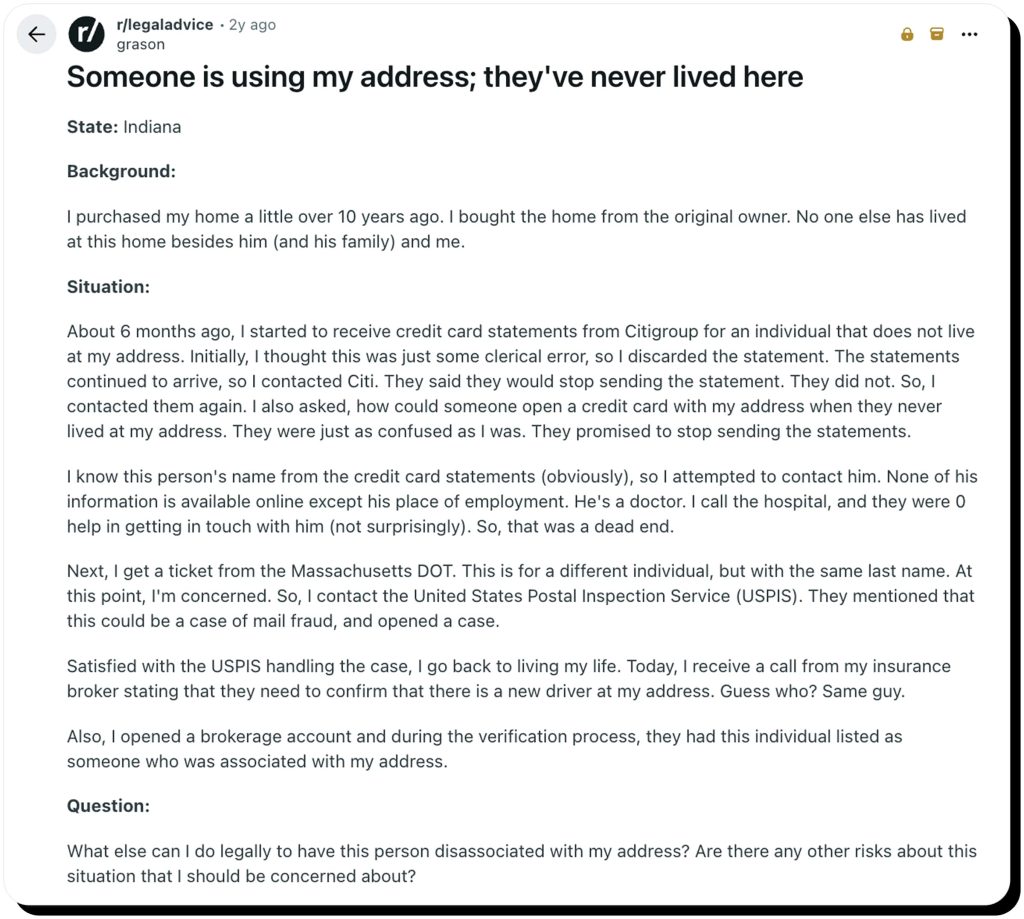
You might be wondering why someone would do this. At first glance, it doesn’t make much sense. The reason behind address misuse could be both benign and malicious.
Mistakes and outdated records
Some unwanted packages are just honest mistakes. It’s entirely possible that the previous resident or tenant never got around to updating their address. An outdated database or an old auto-filled form could also be the culprit. Then there’s human error; even banks, employers, and subscription services make data-entry mistakes.
Fraud, abuse, and other privacy threats
In some cases, someone may use your address deliberately. A fraudster in possession of your name and address can build a surprisingly detailed profile of yours. All they need to do is visit a few data brokers or people-search websites.
Data brokers collect publicly available information in one place and sell it, making these websites a one-stop shop for all your personal details. Namely, your email addresses, age, employment information, and even marital status and Social Security number (SSN).
What are the risks of letting someone use your address? Your home address and other personal details can become the building blocks of various scams:
- Change-of-address scams
- Mail theft and account takeovers
- Identity theft and financial fraud
- Credit, loan, or utility applications in your name
- Manipulation of government benefits, school districts, or insurance rates
- Fake business registrations or marketplace scams
- Avoiding creditors or law enforcement
- Housing and property scams, including fake listings or rentals
- Stalking, harassment, doxxing, or swatting escalation
- Personal safety risks from unexpected visitors
Signs someone is using your address fraudulently
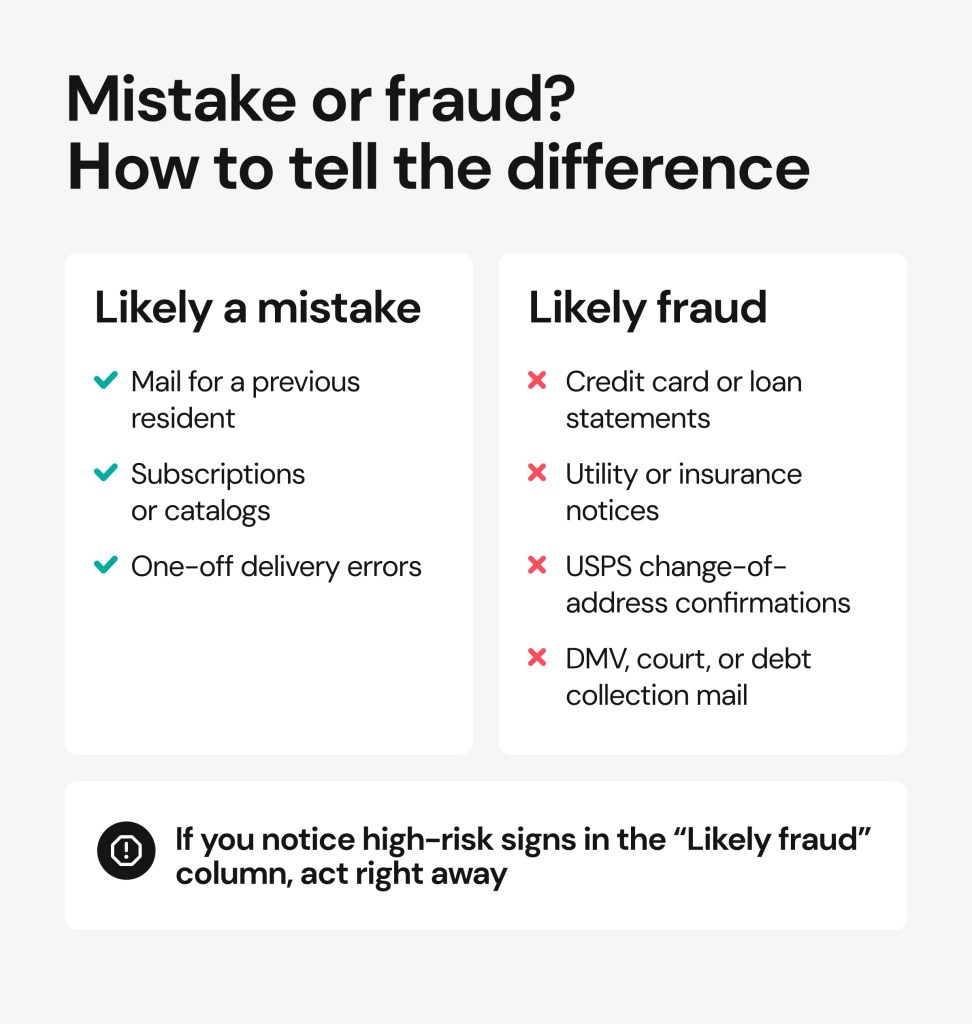
One wrong package is not proof of mail fraud. Here is what signs to watch out for:
Low concern signs (more indicative of a mix-up)
These are the indicators that something is off, but an accidental address misuse is more likely than fraud.
- Every now and then, you receive mail for the previous resident/tenant.
- You get catalogs and/or generic marketing sent to unfamiliar names.
- You’ve received one wrong, misdelivered package.
Although something could be going on, there’s no reason to worry. A mix-up is often easy to fix and benign in nature.
High concern signs (shouldn’t be ignored)
There are times to take it easy, but there are others that warrant swift action. Receiving the following mail strongly suggests that someone has been using your home address on purpose:
- Credit card bills, loan offers, and/or utility statements. It’s like that someone has used your address to apply for credit or services.
- Bank, insurance, or medical correspondence. A trickster could’ve used your address to make an application seem legitimate or to meet residency requirements.
- Department of Motor Vehicles (DMV) notices, toll violations, or court documents. Government agencies rely on address records for legal notices. Receiving a DMV notice may suggest your address was listed on a license, vehicle registration, or legal filing. This could make you liable for someone else’s legal violations.
- United States Postal Service (USPS) change-of-address confirmations you didn’t request. This often indicates someone attempted to forward mail from your address. In some cases, it’s a tactic to intercept sensitive documents before they reach the rightful recipient.
- Debt collection letters or verification calls. Collectors contact addresses linked to unpaid accounts. Even if your name isn’t listed, your address may now be tied to someone else’s debt.
- Account verification prompts listing unknown names at your address. These usually happen when companies are trying to confirm whether a person actually lives at your address.
How to stop someone from using your address for mail
If you’re tired of odd packages, read on to learn how to stop someone from using your address.
Step 1: Handle misaddressed mail correctly
If you happen to receive the wrong mail, let the USPS know about it so they can update their records.
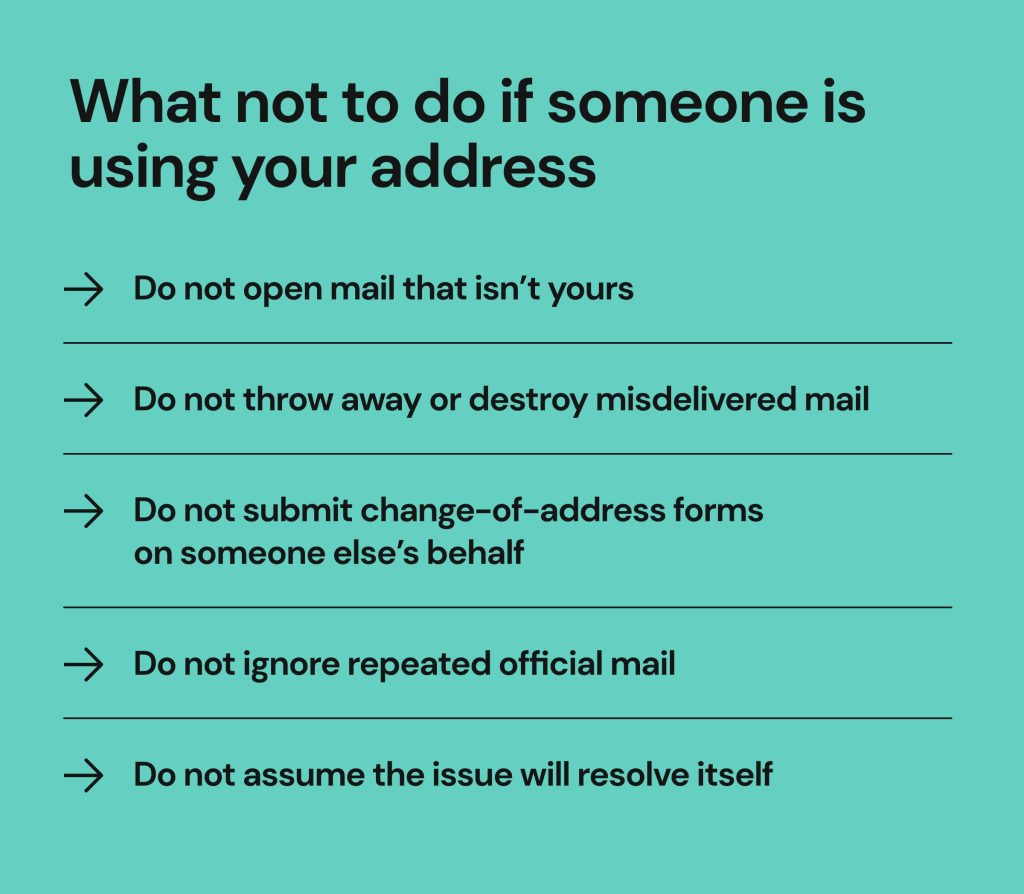
- Write “Not at this address” on the envelope and return the package by placing it in outgoing mail or giving it to the courier directly.
- Do not open the package, alter the contents, or destroy the package. You can only return unopened packages. The ones you open will have to be repackaged.
- If the package keeps coming back, cross out the barcode so it doesn’t get redelivered by default.
Step 2: Create a simple incident log
If someone is stuffing your mail with misaddressed packages, make sure to document everything. This incident log doesn’t need to be complex; just consistent.
Record the following information:
- The date you received the wrong package
- Sender name
- Name listed on the mail
- Tracking number, if available
- Photos of the envelopes or shipping labels
What’s the purpose of this record-keeping? You might want to contact the sender or prove that someone misused your address later.
Step 3: Contact senders who keep using your address
If mail keeps coming from the same source, reach out to the sender directly, whether it’s a bank, lender, insurance company, healthcare provider, or just a subscription service.
Let them know the recipient doesn’t live at your address and ask them to remove your address from their records. Most companies will flag the issue and fix it right away. Once you receive a confirmation, record the date, time, and any other details.
Step 4: Use USPS tools to monitor activity
USPS offers tools that can help you stay in control of the situation.
- The Informed Delivery tool. This tool lets you preview incoming mail online. You’ll be aware of what’s coming and from whom.
- Mail holds. You can postpone mail when you are away from home.
- A locking mailbox or Post Office (PO) box. If available, set up a locking mailbox that can only be opened by a code or key, or rent a mailbox at your local post office. Both are good ways to have more control over your mail and prevent tampering or theft.
Step 5: Escalate when fraud is likely
Someone is using my address, and it’s related to financial accounts, legal notices, or mail forwarding. What should I do?
Take these steps to minimize damage:
- Reach out to USPS/USPIS. If you received change of address requests you didn’t ask for, financial or legal documents, credit card statements, bank statements, government notices, or other sensitive mail, reach out to the US Postal Inspection Service (USPIS) or USPS. Explain what’s going on and ask them to prevent repeated deliveries. USPIS can also investigate the matter further.
- Contact the police. At any sign of a crime being carried out, file a police report. This can be mail suggesting identity theft (such as bank, insurance, or tax notices), someone using your address for credit accounts, loans, or utility services, or even threats, harassment, and unauthorized visits to your home. The goal is to create an official record of the event, so that you can later dispute charges and take legal action.
- Report the issue to the FTC. Get in touch with the Federal Trade Commission (FTC) if the mail is linked to financial fraud or government activity. Head over to identitytheft.gov and obtain your personalized recovery plan. You may also place a fraud alert on your credit report or freeze your credit entirely.
What to do if someone is using your address for credit, utilities, or benefits
Review credit reports for unfamiliar address associations
Request a credit report from all three major credit bureaus in the US (Equifax, Experian, TransUnion) and look closely at the personal information section.
Watch out for:
- Addresses you’ve never lived at
- Unknown names linked to your address
- Accounts or inquiries you don’t recognize
An unknown address may indicate that your home address is being used for fraudulent credit or service applications.
Place a fraud alert or credit freeze if necessary
If there are signs of someone using your home address on purpose, the end goal could be financial fraud. Therefore, it makes sense to take some safety precautions.
- Set up a fraud alert. An alert warns lenders to check your identity more carefully before approving new lines of credit.
- Freeze your credit. This way, no credit will be approved in your name. If you want to get a loan, you’ll have to lift the freeze first.
Dispute incorrect address links with credit bureaus
You need to let the credit bureaus know about the mistake.
File a dispute with each of the major US credit bureaus. Explain the situation, let them know that the person doesn’t actually live at your home address, and request that the incorrect address be removed from your report. As always, keep records of written responses just in case.
Contact the company’s fraud departments directly
Next step: fixing the mix-up with the institutions.
Reach out to the security and fraud departments of your utility providers, credit card company, and any relevant government agencies or benefits offices. Tell them somebody is using your address without your consent. Insist on getting a written confirmation that your address has been removed from their account.
Keep proof of residency available (lease, deed, utility bills)
At some point, you may need to show that you actually live at your address. Prepare a document confirming this, such as a lease, property deed, utility bills in your name, or, even better, a government-issued ID showing your address.
Other common edge cases readers worry about
Scams can go so many different ways. Here are some of the less typical ways in which address misuse might still be a concern.
Someone is using my address but not my name
Someone is using my address for mail, but my name is not listed. Does it still matter?
Yes, it does. Someone might be doing it to meet residency requirements or make an application seem more legitimate.
The same resolution steps apply. Return the misaddressed mail as previously described, contact senders to remove your address, and document everything.
If the volume of packages increases, or you receive financial, legal, or government mail, consider the misuse purposeful and escalate to the authorities.
Someone used my address for a fake business or listing
A fake business, online storefront, or rental listing might be using your home address to boost credibility. While not inherently harmful, this can be an issue in the long run.
How to stop someone from using your address for business purposes?
Collect evidence such as screenshots of the listing, business names, URLs, and any mail tied to the business. Then, report the fraud to the platform hosting the business’s website and your state’s business registry. If packages are involved, you may also reach out to USPS and USPIS about the issue.
I keep getting packages for someone I don’t know
Is an unknown recipient listed on your packages? This could be due to a simple delivery error or an old address not updated.
However, it could also be a brushing scam. A brushing scam entails sellers shipping low-value items to real addresses to create fake reviews.
It’s important not to open the package and send it back. Mark the envelope as “Not as this address” and leave the package with the outgoing mail or the courier.
Data brokers and people-search sites: how your address gets exposed in the first place
Data brokers and people-search websites collect and resell publicly available information. The data comes from public records, social media, marketing lists, and so on.
Once your address is linked to a name, it can be cross-referenced with other records to expose:
- Your phone number
- Email addresses
- Family members and household links
- Marital status and age
- Employment
- Estimated financial status
- Credit-related indicators
- In some cases, partial or even full SSNs
Unfortunately, one piece of information can be used for multiple scams. Your address can show up in credit applications, fake business listings, mail forwarding attempts, or account takeovers because it’s already been validated somewhere. That reuse is what turns a single exposure into repeated problems.
How to find where your address appears online
Identifying where your address pops up online is a good place to start troubleshooting.
- Search for your name, city, and street name. See what comes up.
- Check listings that show “previous addresses” or link you to relatives.
- Look for profiles that mix correct and incorrect details. That’s often a sign of data aggregation.
You can also use Onerep’s free scan to check 317 data brokers and people-search sites and see where your address and personal details appear online. This helps you understand the scope of exposure before deciding what to do about it.
How to reduce the chance someone uses your address again
How do I stop someone from using my address over and over again?
Opt out of data broker websites. If you have enough time and energy, you can opt out of people search websites by yourself, manually. Keep in mind that there are hundreds of these websites, and you’ll need to monitor for reappearances.
If not, remember that you can leave it to experts and rest assured your digital identity is protected.
How Onerep helps remove your address and reduce your risks
Onerep automatically scans hundreds of data brokers and people-search sites for exposed address records, and pinpoints where your address is publicly listed.
The tool proceeds to submit removal requests on your behalf and then verifies each removal. The sites are also continuously monitored for your data reappearance and needed, Onerep resubmits removal requests to make sure your information stays hidden.
Minimizing your digital footprint can truly help reduce the risks of repeat address misuse, scam targeting, and identity theft.
FAQs
What are the risks of letting someone use your address?
First of all, you shouldn’t allow strangers to use your home address for any reason. It can lead to unwanted mail, debt collection notices, or being linked to accounts or legal issues that aren’t yours. In more serious cases, your address could be used for fraud, fake businesses, or benefit applications.
Can someone use my address without me knowing?
Address misuse is not only receiving packages that aren’t yours. Someone could be quietly using your address, without you even knowing. They may list it on online forms, which gets picked up by data brokers, or use it for change-of-address requests. Many people don’t realize it’s happening until they receive official mail, credit offers, or verification notices for someone they don’t know.
How do I stop someone from using my address?
Start by labeling misaddressed mail as “Not this address” and returning it. Document all repeated incidents. Contact senders who keep using your address and ask for removal. If misuse continues or involves financial or government mail, reach out to USPS or USPIS, review your credit reports, and escalate to the companies’ fraud departments or authorities if needed.
Can someone get in trouble for using my address without permission?
If they did so with a deceptive or malicious intent, they absolutely can. Mail fraud violates several state and federal laws. Using your address to mislead others, gain financial benefits, avoid obligations, or commit fraud can carry legal implications.
Can I sue someone for exposing my address?
In most cases, exposing an address alone isn’t enough for a lawsuit. Legal action usually requires proof of harm, such as financial loss, harassment, or safety threats. Still, document everything. If exposing your home address is part of a more elaborate scheme, documenting the beginning of it can help you carry out the legal action.
How do I remove my address from people-search sites?
You can request removals directly through each site’s opt-out (these DIY removal guides will help). Be prepared to spend some time on this task and do it regularly. Services like Onerep automate this process by scanning hundreds of data brokers, submitting removal requests, and monitoring for re-listings over time.


Mark comes from a strong background in the identity theft protection and consumer credit world, having spent 4 years at Experian, including working on FreeCreditReport and ProtectMyID. He is frequently featured on various media outlets, including MarketWatch, Yahoo News, WTVC, CBS News, and others.